From Agrichemicals to Advocate: Rex Sunde Honoured
In a classic story of poacher turned gamekeeper, Rex Sunde ditched a career in agrichemicals to help New Zealand winegrowers minimise their spray use.




 increase font size
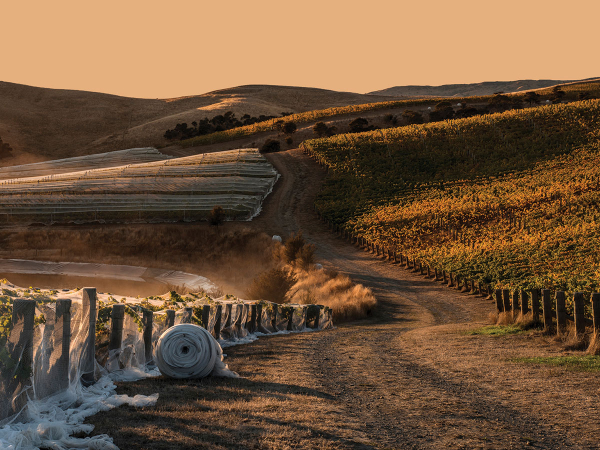 Settlement Vineyard
As New Zealand’s wine regions mature, some unique vineyards are quietly moving out of the background and onto the front label. Emma Jenkins MW explores the relationships and reputations being grown on extraordinary sites, shared by many.
New Zealand’s modern wine industry is barely 50 years old. Set against say, Burgundy’s millennium of accumulated understanding of vineyards and varieties, that is a mere blink.
Yet already across the country a particular style of vineyard has emerged. Not one based so much on the classical Old World codification systems but through a more organic process of building reputations and relationships across shared use of fruit.
The vineyards attracting attention, such as Two Terraces in Hawke’s Bay, Grava in Martinborough, The Wrekin, Clayvin, and Settlement in Marlborough, and Central Otago’s Calvert, share certain characteristics: they are typically grower-owned, and their fruit is sought after by multiple producers, often small and independent.
Increasingly, the vineyard names appear prominently on front labels, not hidden in a back-label blurb. The timing of this development is not coincidental, drawing together as it does the threads of vineyard maturity, changing economic models, and the need for diversification and individuality in an increasingly commodified market.
Plantings on many of these vineyards are now old enough to have demonstrated genuine consistency and character across vintages (and winemakers), while the growers who have farmed the same land for two or three decades have accumulated intimate site knowledge. Meanwhile, the regional designations that have built New Zealand’s international reputation have become not only foundations, but in some cases also ceilings. Once a regional category begins to function as a commodity, differentiation has to come from somewhere else.
Subregions and single vineyards are the logical steps along this path, helping create rungs on the ladders of terroir and premiumisation. But the approach of these particular vineyards is not simply an example of New Zealand speed-running its own version of a Burgundian cru system.
What is actually developing is something more interesting and arguably better suited to our young industry – an approach that could better value both growers and producers, create entry points for a new generation of producers, and provide space for variety and style diversity that volume-driven models tend to suppress.
Hawke’s Bay winemaker Amy Hopkinson-Styles, who owns Halcyon Wines with husband Olly Styles and sources fruit from Two Terraces, says the benefits of this system are myriad, especially for smaller producers. “Access to organic fruit and less common varieties, a recognised vineyard, being part of community, working with a grower who is passionate about wine, and collective storytelling,” she ticks off. “It would be great if we could explore ways for growers to benefit more from their wineries’ successes.”
The model can offer growers something that more conventional contracts rarely do: visibility. Viticulture is to some degree the invisible player in wine, with fruit often disappearing into someone else’s brand; someone else’s story. Single vineyard labelling partially corrects that and, by extension, growers whose names and vineyards appear on an array of premium bottles can gain not just potentially a price premium but also a form of professional recognition that many find genuinely meaningful. Some even use it as a springboard for creating their own labels.
The economics are often more stable than first thought – relationships built on collaboration and shared purpose can prove more durable than procurement contracts driven purely by volume and price. Alistair Gardner, owner of Grava in Martinborough, says in a world where there is already a lot of wine, the grower-producer model feels like a sensible and sustainable way forward. “Rather than everyone needing to own land and infrastructure, it allows vineyards to be farmed well and fruit to be shared among producers who value the site. That spreads both the opportunity and the responsibility.”
For smaller and younger producers, the significance of this approach is hard to overstate. Land prices have made vineyard ownership increasingly inaccessible for anyone entering the industry without substantial capital, so the grower-producer relationship can become an entry point and a way of accessing high quality fruit, without the barrier of ownership.
Jannine Rickards, who sources fruit for her Huntress label across a wide range of growers, says it’s a positive shift. “It brings the spotlight not just onto the winemaker, but onto site, whenua, and the wider community around the wine. There’s a bit more transparency and connection in that, and I think people are increasingly interested in those stories.” It’s “a slightly chaotic” way to work across regions, she adds, “but I really enjoy it – the people, the places, and the way it lets me explore different expressions of variety and style”.
Blank Canvas co-owner Sophie Parker- Thomson MW says the model is a chance to involve the grower more in the winemaking process. “They’re not simply waving goodbye to it at the farm gate.” Meanwhile it enables greater flexibility for the producer. “We know how capital-intensive land is and how many barriers there are to land-ownership – it enables you to do something high-quality on a small scale.”
It can also help find commercial pathways for grape varieties that might otherwise be blended into obscurity or pulled out. Dominated as we are by one variety, the implications of this for diversity of style and variety in New Zealand wine are significant. Growers with Chenin Blanc, Gamay or Cabernet Franc on compelling sites increasingly have multiple producers interested in exactly those varieties, alongside a story that celebrates them.
Sometimes they’re unexpected, as with Dan Brennan, owner of Decibel Wines in Hawke’s Bay. “I’d never made Chenin or Albariño before, but I loved Ian and Linda [Quinn, from Two Terraces] so much I took some. Turned out great!” he laughs.
Time is the one variable in wine that cannot truly be shortcut. New Zealand’s industry has compressed the typical trajectory, and it’s probably too early to tell what the successes and casualties of that might be. What can be said though, is that increasing collaboration between growers and the producers willing to stake their reputations on their vineyards is creating a durable foundation. As Jannine observes, it relies on strong relationships and a bit
of flexibility, both practically and financially. “But when it works, it’s a pretty special way to make wine. There’s a shared sense of purpose.”
Two Terraces, Hawke's Bay
former sheep farm spread across two stepped river terraces in inland Mangatahi has quietly become one of the more interesting vineyards in Hawke’s Bay – and a leading protagonist in the grower-producer model. Owned and farmed by corporate refugees Ian and Linda Quinn, Two Terraces currently works with 19 producers, who are allocated rows within each block. In 2025, 61 picks were made across its six varieties, half of which are five clones of Chardonnay, the balance a medley of Albariño, Chenin Blanc, Gamay, Pinot Noir and Syrah. The Quinns purchased the property in 2015, planting one terrace in 2016 and the other in 2018. Most of the vineyard is now certified organic or in conversion, and it is pretty much “fully allocated”, says Ian. “As we’ve acquired producers, we’ve tended to keep them,” he laughs. “There’s no pressure, it’s all about ideas and collaboration. Short-term or transactional relationships don’t build growth.” Producers span established names such as Kate Radburnd and Tony Bish, to tiny newcomers such as Tawhiti and Three Fates, with Two Terraces fruit now underpinning numerous single vineyard wines as well as being a key component in significant blends. The Quinns work closely with producers in the vineyard and clearly relish the relationships –Linda is responsible for now legendary harvest cheese scones. Last year they hosted a Two Terraces trade tasting and masterclass in Auckland together with 12 different producers. “You get back as much as you put in, and we now have a much richer life,” Ian says.
Grava, Martinborough
Winemaking couple Alistair Gardner and Karla Falloon purchased Grava in 2014, having returned from overseas and completed a vintage at a winery sourcing fruit from the vineyard. “I really liked the site and it was for sale, so six months later, we bought it,” Alistair says. Grava, named for the alluvial gravels on which it sits, is a slightly cooler and more wind-exposed site than the Martinborough Terrace proper. Existing supply contracts came with the property, a model they have built on steadily, underpinned by a conversion to organics that increased both fruit quality and the vineyard’s appeal to like-minded producers.
Alistair says they work with their clients to agree on desired varieties and clones early in the season, “setting clear goals with the buyers of the grapes from the beginning”. Winemakers are involved in conversation throughout the season, but day-to-day decisions remain with Alistair and Karla. “Our clients trust us to manage the vineyard to produce the best fruit we can. It’s fascinating to see the site interpreted through different hands. Each winemaker brings their own lens, but the vineyard character still comes through – the structure, the savoury thread, the sense of place.” The arrangement has also provided stability while the Grava brand itself was repositioned. As for what comes next: alternative varieties are on the radar, he says. “Watch this space.”
Clayvin, Marlborough
Clayvin was a pivotal site in Marlborough’s viticultural history, as the first hillside site planted on the clay-rich, north-facing slopes of the Southern Valleys, back in 1992. The 13.4 hectare organic vineyard was originally developed by Swiss winemakers Georg Fromm and Hätsch Kalberer, and Giesen Wines leased a section from 2013, before purchasing the vineyard in 2015. Planted in Chardonnay, Pinot Noir and Syrah, Giesen Wines’ chief winemaker Jeremy Tod believes its high-density planting – an average of 5,300 vines per hectare – is central to the site’s character, controlling vigour and concentrating energy into fruit rather than leaf growth. He says the result is consistent floral aromatics, concentration on the palate and vibrancy across varieties, something that appears particularly pronounced in Clayvin Chardonnays.
Jeremy notes that the high clay content’s water holding capacity also supports vines through dry seasons, aiding consistency across vintages. Currently, three producers work with the fruit – Giesen, Fromm and Te Whare Ra – with each taking the same parcel year after year, a continuity that Jeremy says allows deep block-level understanding, while permitting each winemaker to express their own style.
“Each producer brings a different vision. But the underlying site character remains a unifying thread across the wines.”
Jeremy believes the grower-vineyard model is gaining more visibility thanks to the likes of Two Terraces and The Wrekin, “particularly through their association with high-end, small-scale producers”. There is a greater focus now on site expression and provenance, he adds, “and grower vineyards with strong identities are well positioned within that shift”.
Wrekin, Marlborough
When Jan and Andrew Johns took over the family sheep and beef farm in Marlborough in the late 1990s, they saw opportunity to diversify into grapes. They were advised to plant Pinot Noir on The Wrekin’s slopes and clay loam soils, well before the Southern Valleys subregional concept emerged. They planted in 2002 and began building supply relationships with a small group of winemakers from their first vintage in 2004. Today, that group has expanded considerably, with around 15 single vineyard wines produced from the site each year by an array of mostly small, premium-focused producers – something that accelerated as they moved into organics and planted Chenin Blanc and Chardonnay.
Their daughter Anna Johns says Jeremy Hyland, who manages the vineyard and was instrumental in a shift to biodynamic practices, is central to The Wrekin’s innovation and quality. “His industry connections seeded the original relationships, and he keeps the jigsaw of multiple producers running smoothly.” Different winemakers have developed preferences for specific clones and aspects over time, and the results, while varied in style, share what Anna describes as “the same underlying density, acidity and fruit concentration.”
The Wrekin also produces its own label (made by Hätsch Kalberer), giving the Johns a direct window into what the site can do. “Being ‘just a grower’ puts you at the mercy of the market and industry challenges,” Anna says. “By diversifying further to the ‘grower-vineyard-producer’ model, we’ve become more resilient in seasons where our producers wish to pull back on their typical allocations. It isn’t a flawless plan but from the start our own production has provided confidence in the value of our fruit – and evidence that the extra work and energy channelled into outstanding viticulture can result in some incredible wines.”
Settlement, Marlborough
Credit for Settlement Vineyard has to go to Ivan Sutherland, says Steve Planthaber, “He had the foresight back in 2007, back when there wasn’t a lot of fruit up here, to see what this site could be.” The organically farmed, clay-rich hillside site in the Omaka Valley, dedicated to Pinot Noir, is owned by Steve, his wife Kirsty Sutherland, and the Sutherland family. It supplies fruit to the Settlement label, but also to a handful of other producers such as Blank Canvas and Corofin, who make single vineyard wines from there. “Ivan always had his eye on this site and snapped it up as soon as he could,” Steve says. “From day one, it was planted as a high-quality Pinot Noir site.”
North-facing, with good sun exposure and protected from wind, there’s broad clonal diversity across 20 separate blocks, which are divided across the various producers. Steve regards Settlement fruit as always having had a strong sense of place, something Corofin owner and winemaker Mike Paterson describes as “radiating with a warmth and succulence”. Blank Canvas’s Matt Thomson agrees, noting that the site’s warm, sheltered aspect and clay soils consistently produces fruit with thick skins and abundant tannins, delivering wines with “darkness, size and structure”.
Sophie Parker-Thomson MW likes the contrasting aspects of Settlement, from a larger east slope to the north-northwest facing Back Block she and Matt take fruit from. “So you’re going to get quite diverse expressions from any given year and not just because of the producer’s winemaking style.”
Calvert Vineyard, Central Otago
When Owen Calvert purchased 12ha of a newly subdivided block on an old sheep farm on Felton Road, Bannockburn, in 1989, it was almost sight unseen. Living in Bhutan at the time, his brother posted him photos and he said, “I like the look of that one”, not entirely sure whether he’d return to plant olives, or maybe stone fruit. But vineyards were going in all around, and in 1999 he planted 4ha of Pinot Noir, alongside smaller parcels of Chardonnay and Riesling. Owen never imagined that some 30 years on, he’d have his name on the labels of some of the country’s most renowned producers. “Whenever I see a list of top New Zealand wines in the world, we’re there as well.”
Having spent the past 40-odd years overseas working for non-governmental organisations in the likes of Somalia, Kenya and Bangladesh, Owen was happy when Nigel Greening – who had just purchased Felton Road Wines – approached him in 2001, keen to purchase the fruit and manage the vineyard. It was converted to organics in 2003, and by 2006, Felton Road, Craggy Range and Pyramid Valley all produced Calvert Pinot Noirs. In 2012 Owen sold three blocks to Felton Road and began supplying Cloudy Bay for their flagship Te Wahi. He credits the vineyard’s reputation to having been “managed well right from the start”, burnished by the calibre of producers who used its fruit. Since 2018, Owen has produced Calvert Pinot Noir under his own label – made by ex-Cloudy Bay winemaker, Sarah Burton – which he describes as a “a true reflection of site and vintage”. With a Calvert Chardonnay in the works, and a move back to New Zealand imminent, a new chapter of Calvert is taking shape.
In a classic story of poacher turned gamekeeper, Rex Sunde ditched a career in agrichemicals to help New Zealand winegrowers minimise their spray use.
OPINION: New Zealand's soils and climate make our wine industry extraordinary. But it is the people behind the vines and wines who make it Altogether Unique.
Covid-19 is creating “amazing opportunities” for wine and viticulture students, says the head of Hawke’s Bay’s viticulture and wine science school. Sue Blackmore, from Eastern Institute of Technology (EIT), says closed borders will make wine students far more valuable to companies during vintage, and vintage experience more valuable for students. “We have to enable these students to get out into industry as soon as possible… to hit the ground running.”
New Zealand wines have notched up a record number of top awards at the prestigious UK-based International Wine and Spirit Competition (IWSC).
As Chinese tourists flock to our shores, the New Zealand wine industry could help enhance their visits by catering more specifically to their needs and tastes, Lincoln University research suggests.

One of Australia's most decorated winemakers will speak at the Aotearoa New Zealand Chardonnay Symposium in Hawke's Bay this September.
The third Aotearoa New Zealand Chardonnay Symposium will be underway in Hastings, Hawke's Bay, on 17-18 September.
In early May, New Zealand Winegrowers delivered a webinar for members, providing a commercial view of New Zealand wine in…