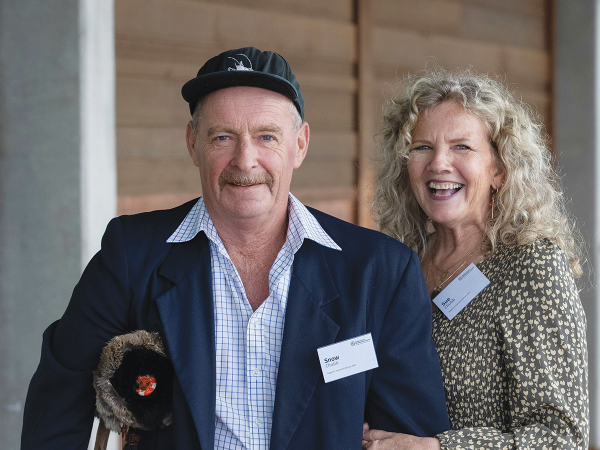
Thirty years ago, as a young sharemilker, former Waikato farmer Snow Chubb realised he was bucking a trend when he started planting trees to provide shade for his cows, but he knew the animals would appreciate what he was doing.
“Cows suffer heat stress in summer which affects milk yield – sometimes as much as providing four litres less on a very hot day,” says Chubb.
“So, it was just common sense. Whether you’re a human or a dog or a horse or a cow, it’s the same thing. You don’t like to be standing in the paddock in the middle of summer with no shade.”
Snow says the decision paid itself off “in spades”. His cows were producing between 400 and 440 kgMS with a grass-based farming system, with hay silage and a bit of grain in the spring.
“Because my cows always had shade, they used to just waltz through the summer.”
The decision was also a key reason he scooped the inaugural Waikato Environmental Award, the forerunner of today’s Ballance Farm Environment Awards.
The awards were mooted in 1991 by Waikato farmer and chair of the Waikato Conservation Board, the late Gordon Stephenson, as a way to celebrate farmers who were demonstrating excellence in sustainable land management and environmental stewardship. In the first year of the awards, 40 Waikato farmers entered and Snow impressed the judges with his planting of deciduous trees for his 80-strong herd of cows and his awareness of the importance of water quality.
“I’ve always had an appreciation for water. It’s the first building block of everything because without water you’ve got nothing.
“It made sense to me way back then to use biological-type fertiliser so we weren’t degrading our water quality.”
Snow started sharemilking on his parents’ farm, which he eventually took over from them.
“I was always curious about utilising the land the best way I could. The farm was in terraces so mostly easy farming, but there were gullies that were a natural fit to being planted with natives or production species.”
Snow and his wife Sue planted nearly 3500 trees on the property, a mix of commercial varieties such as pine, blackwoods and lusicanita, which were planted east to west so they would cast shade on themselves and not the grass, and deciduous trees, which were facing the other direction so in winter when they lost their leaves, it stopped the hard frost from staying on the ground.
“Entering the awards was such a great experience because I was actually relieved to have people say, yep, what you are doing does make sense.
“The neighbours thought I was a bit abnormal, so it was good to get positive reinforcement from all the different judges that I was doing the right thing.”
He adds it was equally gratifying to see 150 people turn up to a field day to see what he was doing after he won the Waikato Farm Awards.
“It was an opportunity to put a positive spin on farming and build relationships, including with the council.
Snow went on to become a judge in the Waikato Environmental Farm Awards for the following nine years.
Long-Term Approach
Thirty two years later, Snow Chubb still remembers how exciting it was to actually get to meet Gordon Stephenson.
“It was an awesome experience, and we went on to become good friends,” he says.
Over the following years, Snow and wife Sue strengthened their friendship with Gordon and his wife, Celia, working on several conservation projects in the area. This included building the first 10km of walking tracks, bridges, and boardwalks for the Sanctuary Mountain Maungatautari project, an ambitious plan to ring-fence the 3400ha Waikato mountain to create a mainland conservation ‘island’. The park is New Zealand’s largest fenced eco-sanctuary.
Snow also formed the Pokaiwhenua Stream Care Group and, with the help of the Hora Hora school teachers and parents, planted 2500 native trees in the catchment.
He says his approach was always to take a long-term approach to looking after the land so it would prosper for future generations. “I believe that if you are not improving the land, you are stealing off the next generation.”
From fields to forests, as a young farmer, winning the inaugural Waikato Farm Environment Awards allowed Snow to help shape New Zealand’s farming future.
This year, the New Zealand Farm Environment Trust is celebrating 30 years since the Waikato Farm Environment Awards Trust was formed, paving the way for the nationwide Ballance Farm Environment Awards programme we know today.