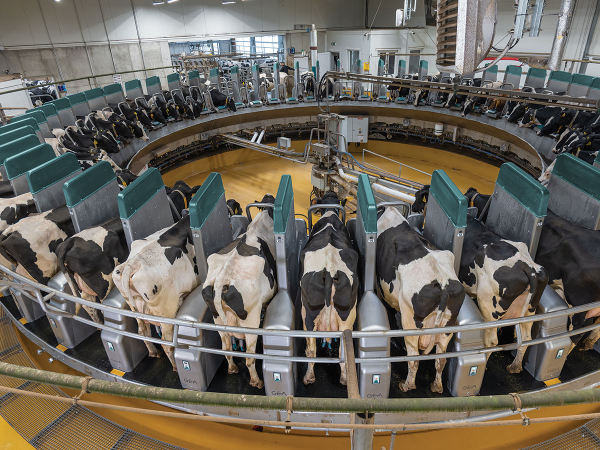
The Dairy ProQ robotic rotary, the first of its kind in the Southern Hemisphere, has proven to be an impressive addition for Victorian farmers Paul and Marsha Smith.
Milking 800 cows at Mepunga East property with two staff, Paul and Marsha Smith are pleased by how their herd is milking through GEA’s fully robotic rotary, the DairyProQ.
The couple wanted to invest in a milking solution that could improve efficiency while maintaining their commitment to a full pasture-based system.
Their old conventional 50-bail rotary, built in 1998, had a limited life span and they were ready for a new era of automation.
The robotic rotary has shown clear benefits not only in milking efficiency but also in workforce savings. Paul has reduced staffing by two full-time equivalents, as the automation lowers the need for manual labour, contributing to long-term savings for the farm.
In terms of cow adaptation, the system has made the transition smooth, with the technology allowing five attempts to attach each teat cup and then the system sends an alert to the monitor. The monitor also shows them exactly what’s happening on the platform, including milk production, cell count and health information.
Deciding to invest in the DairyProQ system wasn’t made lightly. Paul and Marsha spent years researching the technology, talking to GEA experts, and consulting with farmers using similar systems worldwide.
Located 300 meters from the old rotary shed, the DairyProQ offers complete automation of each milking step—from cleaning and milking to monitoring—right within each cup. Equipped with industrial touchscreens and advanced sensors, it provides real-time insights and data, ensuring consistency and quality every time.
A standout feature of the new system is its automation, which has had a noticeable effect on the herd’s behaviour. “When you’re cupping up on a rotary, you’re standing right where they’re walking in. Because there’s no one there now, they’re just piling on better than I’ve ever seen them walk on a rotary.”
Now three years in, Paul says he’s pleased with the investment. The $6 million investment including feed pad, shed, feed system, roller mills and complete dairy is on track to deliver a return in five years instead of the 15 initially projected.
“We haven’t had any major teething issues, and I’m happy we made the investment,” he says.
As he watches his cows confidently enter the rotary, he’s optimistic that this technology will serve his farm well for years to come.