Slovenian manufacturer SIP has released details of a new 10.2m disc mower conditioner combi, alongside two new ranges of twin rotor rakes.
Integral to the Disc- HD1000DFS (10.2m) disc mower combi, is the inclusion of cross conveyor belts that allows it to mow, condition and merge swaths in one operation, while 515mm of side-shift on each side of the cutter is useful when working on tight curves, field corners and across slopes.
Each disc assembly is fitted with the company’s DDSS (Disc Drive Safety System), dating back to 2007, that if subjected to an immovable object, breaks a shear pin integrated into a double flange layout.
As part of the package, Hydro Pneumatic Suspension is said to significantly reduce cutter-bar wear and fuel costs, while the aerodynamic shape of the newly designed skids and 409mm-diameter cutting-discs are said to prevent already cut material from accumulating in the cutter bar area.
In addition, an Overload Monitoring System delivers an early alert to operators as it monitors any rotation speed drops throughout the driveline.
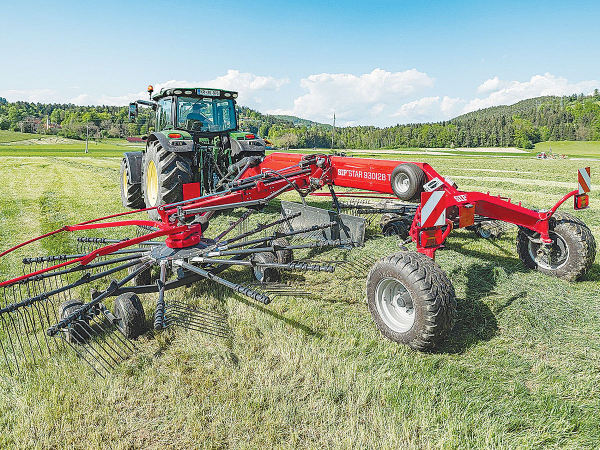
On the rake/swather front, the Star R860/26TS (side delivery) and Star R930/28TC (centre delivery) are aimed at users looking for ease of use, transport and simplified routine maintenance.
Likely to be of more interest in New Zealand, with a working width from 8.15 - 9.25m and said to offer a capacity of up to 13 ha/hr, the Star R930/28TC sits between the existing Star 1000/30T and theR870/26TC.
The side delivery R860/26TS offers a maximum working width of 7.2m when creating a single side swath, or can pull together up to 15m of grass in just two passes, and offer raking capacities of up to 12.5 ha/hr.
Sequential Rotor Lift (SLR), standard on the R860/26TS, allows operators to customise the delay in partial lifting of the rear rotor.
Both ranges are available in standard or advanced ‘H’ specification, the former offering mechanical working height and swath curtain adjustments, while the latter is equipped with hydropneumatic rotor protection and hydraulic rotor height adjustment.
Other features of both ranges include the 155- degree turning angle of the pivoting linkage, integrated with a steering mechanism connected to the rear wheels of the transport frame, the design is said to result in maximum stability on the road with the 9.3m transport frame of the R860/26TS and 6.75m frame of the R930/28TC. Both units offer sub-3 metre transport widths.