Oz dairy in consolidation mode
The Australian dairy industry is heading for more consolidation as milk supply shrinks, according to dairy analyst Steve Spencer.




 increase font size
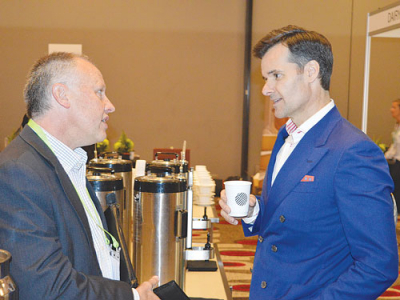 Lino Saputo Junior (right) chats with Richard Lange, Milk2Market at the Australian Dairy Conference..
Canadian processor Saputo, on the verge of becoming Australia’s largest dairy player, looked at investing in New Zealand 16 years ago.
Saputo chairman Lino Saputo Junior told the recent Australian Dairy Conference that three countries had appealed to the company when it looked at the international market: Australia, NZ and Argentina.
Today Saputo is one of the top three dairy processors in Argentina; if the listed Canadian company gets regulatory clearance to buy troubled Australian co-op Murray Goulburn, it will leapfrog Fonterra to become the largest processor in Australia.
Saputo Junior says unfortunately the NZ dairy industry was back then controlled 95% by Fonterra.
“We thought that might not be the best platform for us,” he told the conference.
But Saputo Junior and his father -- retired board chairman Lino Saputo -- visited Australia in 2002 and “fell in love” with the assets of Warrnambool Cheese and Butter Company (WCB).
However, WCB said they were not for sale and the Saputos turned their attention to Argentina, in 2003 making their first purchase outside North America; they bought Argentina’s third-largest processor Molfino Hermanos S.A.
But Saputo Junior says his company never lost sight of how important Australia could be in developing and serving Saputo’s growing international customers.
In 2013 an opportunity arose when listed Australian processor Bega Cheese made a hostile bid for WCB.
The Saputos returned to WCB and renewed their offer to buy the company; by 2013 they had staved off Bega’s bid and became majority shareholders in WCB; last year they bought all the remaining shares in WCB.
Saputo Junior then outlined why his company has invested large in Australia. Notably, milksolids from Australia are held in high regard by international customers, he says.
“Every single market, without fail, would compare [the quality of our solids] with that of solids from Australia, which has a reputation for high quality… The heritage and lineage are here… fifth- and sixth-generation farmers who know the industry extremely well. Australia is a key dairy producing country; the infrastructure was here [and we would not have had to] develop infrastructure to collect and process milk here.”
Australia’s ability to supply the international market was also a factor. Saputo Junior notes that 40 - 50% of Australian dairy products are exported.
“There are not enough consumers here for the total production; regulations here are also favourable. So Australia became‑ an important pathway for Saputo.”
The Australian dairy industry is heading for more consolidation as milk supply shrinks, according to dairy analyst Steve Spencer.
Canadian dairy giant Saputo is continuing its global buying spree, stitching up a deal to buy the listed UK company Dairy Crest.
The growth of Australia’s dairy industry is now down to the two main players Fonterra and Saputo, says dairy analyst Steve Spencer.
Australia's new dairy kingpin is urging co-ops in Europe and New Zealand to rein in milk production and help stamp out price volatility.
Canadian dairy company Saputo says its acquisition of Murray Goulburn will add to and complement the activities of its dairy division in Australia.

High country stations, mixed sheep and beef farms, Māori-owned farms, corporates and family operations are among the nine commercial farms taking part in the Livestock Innovation Farming Transformation programme, known as LIFT.
OPINION: New health and safety guidance unveiled by the Government recently provides farmers greater certainty about what is expected of them when managing risks on farm.
The National Animal Welfare Advisory Committee (NAWAC) is seeking public feedback on proposed changes to the Code of Welfare for Rodeos.
A New Zealand initiative supporting farmers to restore the health of grazing landscapes has received international backing through the Regenerative Fund for Nature, a global collaborative fund supporting regenerative agriculture and the communities that produce natural fibres for the fashion industry.
Combine premium New Zealand products, blend in a family ritual and what do you get? A world-class functional drink.
Entries are now open across eleven regions for the 2027 New Zealand Dairy Industry Awards (NZDIA).

OPINION: It seems Canterbury processor Synlait is still in the doldrums.
OPINION: Get offside with New Zealand First leader Winston Peters at your own peril.




