Cyclone Gabrielle: Hawke's Bay Orchardists Still Recovering
Three and a half years on from when Cyclone Gabrielle hit Hawke's Bay, some orchardists in the region are still receiving counselling to help them deal with the trauma they suffered.



 increase font size
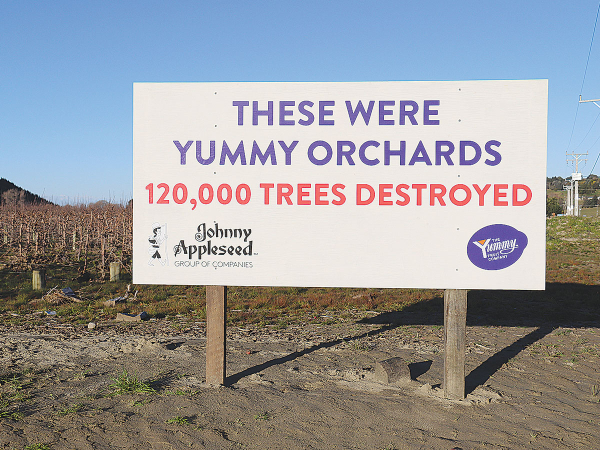 A sign in Esk Valley highlighting losses suffered by orchadists during Cyclone Gabrielle.
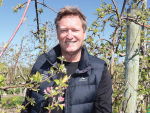
Nearly three years on from Cyclone Gabrielle, Hawke's Bay apple orchardist Paul Paynter says they are still doing remedial work around their orchards and facing financial challenges.
He says the remedial work includes planting new trees and dealing with some surprising things - namely random willow trees that have popped up in among the rows of apples.
The fifth generation family business, the Yummy Fruit Company, lost 180,000 apple trees in the cyclone, most of which were in the Esk Valley north of Napier - one of the worst hit areas. Paynter says they were not able to plant again in that area because banks and financial institutions will not lend money to plant in areas still a risk of flooding - Esk Valley being one such place.
"So, it's a big challenge and we still haven't stopped spending money to get it right," he told Rural News.
"The problem is that with an apple tree, it takes a couple of years to grow a nice nursery tree and pop it into the ground and then you have about four years after that until cashflow breaks even. In effect it takes between six and seven years to get yourself in a better position than you were previously in."
Paynter says the big fear is running out of money and it's no surprise that banks are keen to reduce exposure to the sector as a whole and to individuals in the region. He says his company is still struggling and hasn't made a significant profit since Covid; if they had, it would be a very small one.
"We have had five dire years and it's difficult to survive these days with the banking regulations that are less tolerant of business that have non-performing loans. It's a tough world but it's only a downturn and we have beaten our budget the last two years, and we have got a very good trajectory for the future," he says.
The Yummy Fruit Company only leased land in the Esk Valley and Paynter says much of that land is being used for cropping. He says the problem for growers like him is assets have decreased in value and debt has gone up. He says there is a fear that some businesses will not survive. He says things are in place where, in a normal year, his company would make a profit.
For him and other growers, the big challenge will come in a few years' time, at which stage they'll be looking for extra capital for the future. Paynter says despite the challenges, he's excited about the future with the innovation and new plantings that have gone in and he adds, the future looks brighter than it's ever been.
Three and a half years on from when Cyclone Gabrielle hit Hawke's Bay, some orchardists in the region are still receiving counselling to help them deal with the trauma they suffered.
The chief executive of Apples and Pears New Zealand, Danielle Adsett, says fruit quality this year is phenomenal and the sector is hitting crop estimates, which is great for growers.
A Hawke's Bay apple orchardist supports the Government's objective of doubling exports but says this won't happen in the horticulture sector unless there's a change in the process for bringing new plant material into the country.
A Hawke's Bay apple grower says it's no longer profitable for him to export apples to the US because of the 15% tariff imposed on them by Donald Trump.
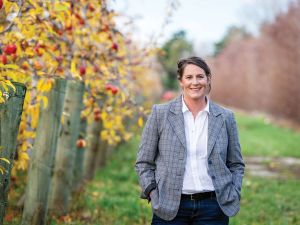
If there was a silver lining in the tragedy that was Cyclone Gabrielle, for New Zealand Young Grower of the Year, Grace Fulford, it was the tremendous sense of community and seeing first-hand what good leadership looks like.


The National Party’s policies to make it easier to grow fresh vegetables, secure reliable water and energy and simplify farm planning are practical changes that will give growers the confidence to invest, according to Horticulture New Zealand (HortNZ).

Fonterra Co-operative Group chief financial officer Andrew Murray has resigned to take up a role outside the dairy giant.
A major move is about to get underway to improve the quality and viability of dairy beef and cattle in NZ.
Veterinarians say changes to the code of welfare for dairy cattle provides a positive foundation for improved cattle welfare across the country.
Today, 15 October, is the International Day of Rural Women, which recognises rural women’s contribution to farming, communities and the environment.
Global dairy giant Lactalis has integrated its Australian operations with the Mainland Dairy consumer business it acquired from Fonterra earlier this year.


OPINION: The same mainstream media muppets that brought you Jacindamania in 2017 have been flat out pimping for the Opportunities…
OPINION: Your old mate reckons the atrocious way farmers in the UK are treated by their lords and masters in…




