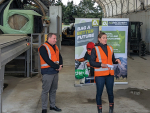
New Rural Recycling Scheme to Replace Voluntary Farm Plastics Programmes by 2027
Environment Minister Nicola Grigg has announced details of a new rural plastics recycling scheme.




 increase font size
 Tony Wilson.
Agrecovery, an accredited product stewardship scheme operator for farm plastics, has launched its latest initiative, allowing for the recycling of wool fadges.
The new scheme aims to advance recycling efforts within the wool industry by responsibly processing High-Density Polyethylene (HDPE) wool fadges into recycled materials.
Under the new scheme, end-of-life HDPE wool fadges would be collected, sorted and sent to Recycle South’s processing plant in Southland for recycling into high-quality plastic pellets for resale.
Farmers in New Zealand have long been adept at repurposing wool fadges for various uses on their farms, often reusing them multiple times to maximise their use. However, despite these efforts, the options for recycling or further repurposing have remained somewhat limited.
The new industry-specific scheme streamlines the recycling process, enhancing the lifecycle of these products within a circular economy, and draws momentum from the New Zealand Wool Dumping Group’s demand for used and repaired woolpacks.
Agrecovery says this collaboration helps decrease on-farm costs to ensure a sustainable future for New Zealand farmers.
Agrecovery chief executive Tony Wilson says the recycling scheme operator is committed to environmental stewardship.
“At Agrecovery, we are dedicated to designing effective stewardship schemes that address industry-specific environmental challenges,” Wilson says.
“The Wool Fadge Scheme is a prime example of our efforts to deliver practical and innovative solutions that not only address a significant waste issue, but also support the agricultural community and aligns with New Zealand’s broader goals for sustainability,” he adds.
Liam Murphy, general manager of the New Zealand Wool Dumping Group, says the scheme aligns with its sustainability goals, promoting a fully cyclical use for wool fadges, from the repair of used wool fadges by New Zealand Wool Dumping Group through to their end of life.
“This is the start of the innovation we have planned in the wool fadge space in which we hope to continue working closely with Agrecovery and Recycle South,” Murphy says.
Meanwhile, Agrecovery commercial manager Richard Carroll says he is grateful for the collaboration and foresight of the wool industry.
“Their commitment has been vital in shaping a scheme that not only addresses key sustainability challenges but also sets a new standard for environmental stewardship within the sector,” Carroll says.
“It serves as an inspiration for future stewardship initiatives and reflects the powerful impact of industry-wide cooperation in addressing environmental issues,” he concludes.
Environment Minister Nicola Grigg has announced details of a new rural plastics recycling scheme.

The Government is introducing a new nationwide rural recycling scheme that will significantly increase the recovery of farm plastics from March next year, Minister for the Environment Nicola Grigg announced today.
Rural contractors will be able to play a role in the revamped agricultural plastic recycling scheme with new regulations due for Cabinet signoff before this year’s election.
Rural recycling scheme Agrecovery is welcoming the Government's approval of regulations for a nationwide rural recycling scheme for agrichemicals and farm plastics.
The Government is calling on rural New Zealanders to share their views on proposed regulations designed to improve the management of farm plastic waste.


Mark Hooper has been appointed the new chair of NZPork, the industry organisation representing New Zealand pig farmers.

As the India-New Zealand free trade agreement enters into force, New Zealand’s apple industry has reaffirmed its commitment to the long-term development of India’s apple sector.
Fonterra shareholders can begin voting on Tuesday 20 October in the 2026 Board of Directors’ election, a Co-operative Council election in one Ward, and seven Annual Meeting resolutions.
National’s pledge to introduce 19 new national standards shows the party is serious about getting Wellington out of farming, Federated Farmers says.
The National Party’s policies to make it easier to grow fresh vegetables, secure reliable water and energy and simplify farm planning are practical changes that will give growers the confidence to invest, according to Horticulture New Zealand (HortNZ).
Fonterra Co-operative Group chief financial officer Andrew Murray has resigned to take up a role outside the dairy giant.



OPINION: The same mainstream media muppets that brought you Jacindamania in 2017 have been flat out pimping for the Opportunities…
OPINION: Your old mate reckons the atrocious way farmers in the UK are treated by their lords and masters in…




