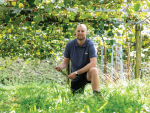
Rabobank Launches HortPathways for Emerging Hort Leaders
Twenty-eight emerging leaders from across the horticulture sector spent two days last month learning valuable skills and connecting with industry experts.




 increase font size
 Rabobank general manager for country banking Bruce Weir says a tight labour market played a key role in lifting wages.
The low unemployment environment is one of the key factors driving on-farm salaries higher over the past 24 months, says Rabobank general manager for country banking Bruce Weir.
“Many farm owners have found it incredibly difficult to source skilled labour over recent years, and this has played a key role in lifting wages as employers have had to pay more to attract and maintain good staff,” he says.
Another major driver of salary growth – particularly for the dairy sector which has a greater reliance on overseas workers – was the Accredited Employer Work Visa (AEWV), he points out.
“Introduced in mid- 2022, the AEWV requires employers to pay at least the median wage to international workers as a condition of the visa, and this has lifted pay for international workers higher,” Weir says.
“This in turn has led to increased pay for domestic workers as employers have increased salaries for this group to ensure pay-parity with their international counterparts.”
Weir made the comments after a new report showed farm employers across the dairy, sheep and beef, and arable sectors have continued to invest strongly in one of their greatest assets – their staff.
The 2024 Federated Farmers-Rabobank Farming Salaries Report shows that since the last report in 2022, the average salary for a farm worker has increased by $7,480 to $71,411 and the weighted average annual salary across the 13 surveyed on-farm position categories has grown by 13%.
“For some more senior roles, the increases have been significantly higher,” Federated Farmers national board member and employment spokesperson Richard McIntyre says.
For example, the average salary for a dairy herd manager is up 19% to $74,185. A sheep/beef farm manager is earning an average 22% more than two years ago ($88,381) and the average income for an arable farm manager is up 28% to $101,264.
McIntyre says the increases are impressive, especially in light of all the headwinds farmers have contended with over the past two years, which have included Covid, severe weather events, production-suffocating red tape, inflation and roller-coaster commodity prices.
“And these upwards salary movements underline that careers in agriculture are not only satisfying, but also pay-competitive,” he says.
Weir adds that while growth in on-farm salaries increased costs for farm owners, it was crucial to help attract young people into agricultural careers.
“Alongside our client councils, Rabobank is involved in a number of activities that focus on highlighting to secondary school students the array of career opportunities available across the agri sector,” he says.
“We know that remuneration is a key consideration for this group when they’re thinking about career pathways and, if we want to attract good young people into the sector, it’s vitally important that growth in salaries for on-farm roles keeps pace with, or exceeds, what is happening across the wider employment market.
“Statistics NZ data tells us that Labour Cost Index wage growth across all New Zealand sectors in the 24 months to December 31 last year was around 11 per cent, so it’s good to see salaries for most of the surveyed on-farm positions growing at this rate or quicker over the same period.”
Twenty-eight emerging leaders from across the horticulture sector spent two days last month learning valuable skills and connecting with industry experts.

A 'tsunami' of milk from key exporting countries is winding down and this may be good news for New Zealand dairy farmers.
Chinese beef trade quotas and a looming suspension of Brazilian beef imports into the European Union are expected to reshape global beef trade flows over the remainder of 2026, with implications for New Zealand exporters, according to Rabobank's Q3 Global Beef Quarterly report.
New Zealand consumers are paying more for beef mince than ever before, with the average retail price now sitting above $24 per kilogram, according to Rabobank.
West Otago dairy farmer Luke Kane has been awarded the 2026 Rabobank Dr John Morris Business Development Prize.


Federated Farmers has welcomed new rural policies released by ACT, saying they align closely with its own election priorities.

Rural Contractors NZ says proposed changes to land transport rules for agricultural vehicles are a welcome response by the Government to out of date regulations which have seen members hit with huge fines.
Alliance is calling for final applications for its 2027 Graduate Programme, with applications closing on Sunday 25 October.
Decades piloting planes has ensured vet and farmer David Hayes is focused on safety. So, after a serious accident while welding on farm, he is sharing his experience so others can learn from it.
Canterbury milk processor, Synlait Milk has confirmed Leon Fung as its chief executive officer.
OPINION: Making it easier to collect rainwater and use it to grow crops and livestock is a no brainer.





OPINION: The same mainstream media muppets that brought you Jacindamania in 2017 have been flat out pimping for the Opportunities…
OPINION: Your old mate reckons the atrocious way farmers in the UK are treated by their lords and masters in…




