What Would Synlait Be Worth to Fonterra or a2 Milk?
Speculation of a possible joint move by Fonterra and a2 Milk to buy Synlait raises a much bigger strategic question, says agribusiness expert Dr Nic Lees.




 increase font size
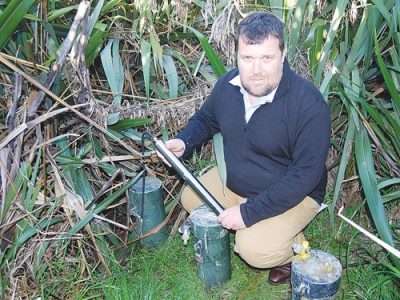 Lincoln Agritech group manager environmental research, Blair Miller, holds a prototype of Agritech’s real-time optical nitrate sensor beside the sampling bores at the Lincoln University Dairy Farm that have been used in the device’s development.
Lincoln Agritech has unveiled an advanced optical nitrate sensor for groundwater which it says will bring a paradigm shift in New Zealand’s groundwater management.
The slim stainless steel device is designed to give real-time data while being cheap and simple enough for widespread deployment. Now at the beta-testing stage, it is hoped to be commercially available by the end of the year.
The Lincoln University-owned R&D company says that, as NZ moves to adopt caps for nitrogen losses to waterways, it “remains unclear” how levels would be reliably measured. Current approaches are based on modelling rather than direct measurement, largely because present real-time sensors are too expensive.
But Lincoln says its sensor should retail for no more than $US5000 and deliver data with accuracy and calibration consistency similar to high-end sensors retailing for $US15,000 - $US30,000 each.
The sensor is housed in a slim cylinder with a single hole through the middle; water flowing through the hole is analysed by shining various wavelengths of light across the flow.
Agritech’s group manager environmental research, Blair Miller, says the device works by measuring the transference of UV light at 220 nanometres wavelength, which is absorbed by nitrates. Other wavelengths detect and correct for factors such as dissolved organic carbon and turbidity from silt.
He says other, more expensive, optical sensors are designed primarily for the wastewater industry and are more complex, having to measure a far greater range of targets and contaminants.
“We’ll never sell this as a wastewater sensor; but this will go down a dairy farm well anywhere in NZ, within reason,” says Miller.
The other devices are also “much fatter”, while theirs is specifically designed to fit in a 50mm bore, which can be direct-driven rather than expensively drilled.
The included electronics allow for easy connection by landline, wireless or cell network, which will also help keep deployment costs down.
Agritech hydro-geologist Jens Rekker says prototypes of the sensor have performed well in monitoring the Hinds/Hekeao managed aquifer recharge project, south of Ashburton.
The year-old pilot project is aimed at recharging shallow aquifers in the district by taking clean alpine water from the Rangitata and letting it seep in from a purpose-built ‘leaky’ pond.
Rekker’s data shows that both the MAR and the new sensor are working as planned. Nitrate concentrations in downstream groundwater are markedly lower, and the sensors’ continuous data correlates well with the nitrate measurements from conventional sampling.
Rekker says the ‘utes and boots’ practice of having a person physically drive out to take a sample which then must be analysed in a lab to get a paper report three weeks later, is “an expensive snap-shotty way of collecting data”.
“We know, especially in the flow field, how much richness that automated data collection provides for us.”
Lincoln Agritech chief executive Peter Barrowclough says the sensor’s ability to vastly increase the amount of data available for decision-making in the whole community will be “huge”.
“We don’t know exactly, yet, how it’ll be used in all circumstances. But we’ve got science programmes running alongside it.
“We’ll sell this to people like DairyNZ, regional councils and NIWA. So they’ll all learn from having more data, so over time we’ll have a much richer data set from which to make better-quality decisions.”
Miller says Overseer “finishes” at the bottom of the root zone but a lot of farmers would have natural assimilative capacity for denitrification below that, which the sensors could demonstrate.
Speculation of a possible joint move by Fonterra and a2 Milk to buy Synlait raises a much bigger strategic question, says agribusiness expert Dr Nic Lees.

Lynnette Hudson's 30-year obsession with Pinot Noir was sparked working vintage in Burgundy, seeing how subtle changes in terroir were expressed in the glass. It was, she says, "an elightening moment in every way".
A four year trial has reaffirmed that mixing plantain into dairy pastures can help reduce nitrogen losses to freshwater while maintaining milk production and profitability, say researchers.
Twenty five secondary school students from around New Zealand recently completed a three day residential programme designed to explore career opportunities across the food and fibre production supply chain.
A Lincoln University student is set to become the first person to contest both the Young Viticulturist and the Young Winemaker national titles in one year.



Now in its fourth year, the 2026 Fencing Industry Awards, formed part of the proceedings of the FCANZ Conference, held in Nelson during August.
DairyNZ deputy chair Cameron Henderson has been re-appointed unopposed for another term.
OPINION: The stats speak for themselves.
Farms across the upper North Island are trialling different pasture mixes as part of a research programme that aims to build greater resilience into farming systems.
Election years are always a concerning time for farmers, according to DairyNZ chair Tracy Brown.
The Ballance Farm Environment Awards are coming to the West Coast of the South Island.


OPINION: The same mainstream media muppets that brought you Jacindamania in 2017 have been flat out pimping for the Opportunities…
OPINION: Your old mate reckons the atrocious way farmers in the UK are treated by their lords and masters in…