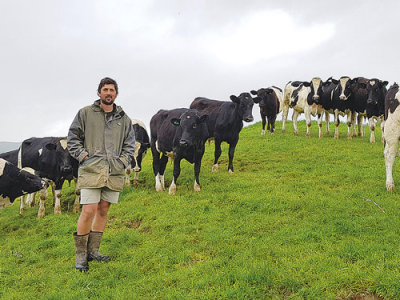
Making sure all livestock coming on and off-farm are NAIT tagged and registered online is every farmers’ responsibility, says Taranaki farmer Nick Brown.
He is a sheep and beef farmer who rears Friesian bulls and winters dairy heifers with his wife Sophie on a 530ha hill country property.
Lifetime animal traceability starts at the farmgate.
That means all cattle and deer should be tagged within six months of birth or before they move off-farm, whichever comes first.
Once the animals are tagged, they must be registered in NAIT within seven days.
“I can’t understand why some farmers are still not doing this; they must be simply lazy or ignorant,” Brown says.
“We had a situation recently where we had heifers coming onfarm which weren’t tagged; we’ve also encountered this with calves too. It shouldn’t be this way, especially after the M.bovis outbreak and all the publicity.”
Brown urges if you have this happen, pull up those farmers up who are doing this.
“As a buyer, you have a responsibility as much as the seller to be stringent,” he adds.
“You have to consider the implications for our agriculture exports; without lifetime traceability we are risking our product integrity and reputation for food safety in the globally competitive marketplace.”
As a younger farmer, Brown reckons most of his generation are equipped and savvy enough to see to their NAIT requirements, with the recording of movements between farms not requiring a great deal of nous.
He believes technology is not a barrier and farmers should be using it more to their advantage.
“I understand that some older farmers might struggle with the computer, but that’s not an excuse. You can call on NAIT-accredited information providers or assign a delegate and they can help with tagging, registering and making sure your NAIT account is kept up to date.
“If you don’t have a wand [livestock scanner], find someone who has and see if they are willing to share it. After all, it’s something you use periodically; otherwise buy one and the benefits will come.
“We use a Tru-test scanner that counts the number of cattle as you scan.
“It is a clever tool as it ensures you don’t scan the same animal twice. You can link it to your smartphone and do the transfers on the spot without leaving the paddock.”
Once animals are tagged and registered, future movements must be recorded and confirmed in NAIT within 48 hours of the movement occurring, with an accompanying animal status declaration (ASD) form.
Farmers, livestock reps and the wider industry should “care a bit more” about their NAIT obligations, Brown says. That means recording online details about the animal type, birthplace, the tag number/s and whether it is intended for beef finishing or dairy sector finishing.
“It is critical to be privy to the information being recorded. The current situation [M. bovis] is bad and could be a lot worse even. Providing these details builds our resilience against a livestock disease and our capability to manage it,” he adds.
“It’s time for farmers to see value in the NAIT system and start using the data to their advantage, to improve their farm, productivity and their defence against a biosecurity incursion.”