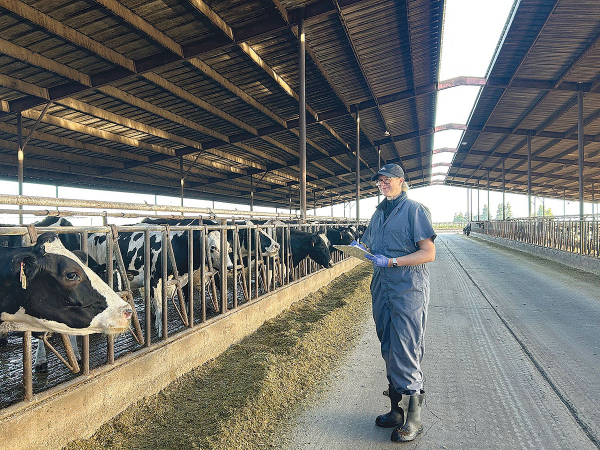
Whatever an animal is raised for, it deserves a good life — and just as importantly, a “good death”.
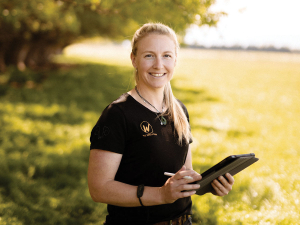
That’s the ethos that drives internationally respected animal welfare and behaviour scientist, Dr Karin Schütz.
“As a society we have made choices about how we use animals, and we know they are a very important source of protein for people. But I think we have a moral obligation to them if we are to use them for food. Because it’s the right thing to do.”
Schütz’s passion for animals growing up in Sweden could have easily led her to being an activist in another life. But through her studies and moving to New Zealand —where she has been living now for 20 years as a scientist for AgResearch — she realised the best way to make a positive difference was through research.
“I want to have opinions. But I want to look at the evidence to tell me what we should be doing. We need that robust science. I don’t just want to base it on feelings.”
Livestock welfare has long been recognised as important for New Zealand as an export nation reliant on industries such as dairy farming. But in tough economic times, with so many challenges in front of farmers, funding for animal welfare and behaviour research has been much harder to come by.
While there are always outliers, Schütz’s experience of New Zealand farmers is that they want the best for their animals. The research is about supporting them in that, as well as helping to maintain a social license, she says.
Issues such as the live export of farmed animals still generate strong public debate, while increasingly welfare is being seen as an economic and productivity issue, as much as it is a moral or ethical one.
When New Zealand’s new free trade agreement with the United Kingdom came into force in 2023, it included — in a first for New Zealand — a chapter that recognises “the high priority that NZ affords animal welfare in farming practices and acknowledges the comparability of both countries’ high standards in this area”.
The chapter commits both countries to use “best endeavours” to not weaken or reduce the protection afforded to the welfare of farmed animals “in a manner materially affecting trade or investment”.
“Obviously we need high welfare standards, but we need it right across the board,” Schütz says.
“Because if one sector falls behind, it can drag everything down. And that’s when other countries can start to move ahead of us.”
Schütz’s work in New Zealand has ensured important progress on issues such as heat stress in livestock, including the development of heat load indexes as a tool to guide livestock industries and farmers.
She has also studied the conditions in which animals are grazed through winter, and ways to help them find greater comfort in the cold and wet.
Because you can’t just ask a cow or sheep how they are feeling, or what they like or dislike, scientists have learned to design sophisticated experiments to test preferences and motivations in different situations. Likewise, technologies to monitor behaviour such as lying or rumination times can help to provide insights.
For Schütz, it was quite an adjustment moving from experiments earlier in her career with red jungle fowl (the wild ancestor of chickens), to the likes of cattle.
“I just remember that they were much slower than chickens. The cow can just stand there and look at you for five minutes, whereas the chicken would be doing 50 million things. Any animal that you study, you just get more and more interested in what they are doing and what they are thinking.”
Nothing beats knowing your animals and being around them, Schütz says, which is where farmer observations are critical.
When it comes to death of the livestock, whether slaughtered or subject to euthanasia for health reasons, the research has been able to help guide the best methods to minimise pain and stress in that process.
Schütz’s boss at AgResearch, Animal Welfare and Behaviour science team leader Cheryl O’Connor, says New Zealand is lucky to have scientists of the calibre of Schütz who have made their mark here and internationally.
“Research over the last few decades has changed how we think about animal welfare,” O’Connor says.
“It is now widely accepted that animals can have conscious mental experiences, affective states or feelings. In 2015, New Zealand’s Animal Welfare Act was amended to include animal sentience, or the ability to perceive or feel things. In simple terms ‘animal welfare is the quality of life as perceived by the animals themselves’.”
Even when out hiking or relaxing at the beach with her partner and 11-year-old son, Schütz says the animals and their wellbeing are never far from her mind. People inside or outside of her working life are always keen to discuss it with her.
“I don’t want to switch off. I wouldn’t have it any other way.”