Early Weaning Lambs: What the Massey Trials Found
Farmers with high-quality feed available in late spring could consider weaning at least a proportion of their lamb crop early to benefit both lambs and ewes.




 increase font size
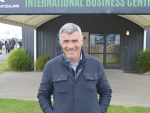
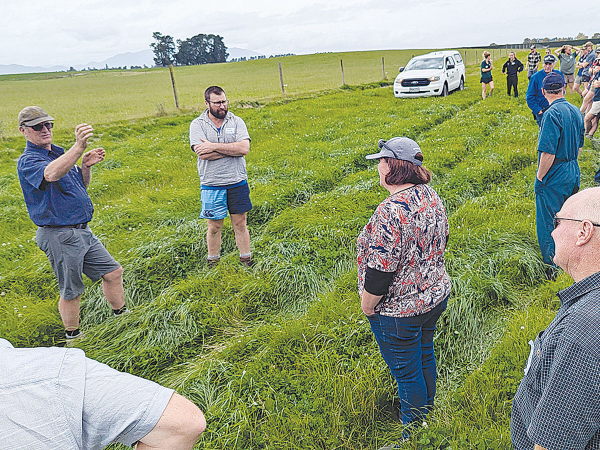 Stu Stokes (left) explains some of his deer weaning and management practises during a field day on his farm at Sheffield.
Management practices that aim to cull the poor performers rather than boost the best are a key to success for Canterbury deer farmer Stu Stokes.
Stokes runs a red deer venison and velvet operation on a 240ha block at Sheffield which has been in the family since 1987. He took it over about 2000, adding a nearby 140ha “top block” in 2001.
He recently hosted a weaning management field day on the farm, which was organised by the local Deer Farmers Association branch and the Deer Industry Association of New Zealand (DINZ). The event attracted about 80 attendees.
It is not a stud but a purely commercial farm and is run accordingly, Stokes said.
This year he will be wintering about 900 stags, 600 in-calf hinds, 160 weaner stags and 270 weaner hinds.
“Deer were always my passion, and hinds were always to me the powerhouse behind it,” he said.
Stokes said he has dyslexia but the power of that was it lets him think outside the box, with a lot of things on farm done quite differently. He also runs a lot of custom machinery of his own design.
“My focus is probably more on the bottom 10% of anything. So, I don’t really care about my top producing stags.
“It’s the bottom 10% of your operation that’s costing you money.”
Stokes weans before the rut, aiming to have weaning complete by February 25, with mating due to start on March 9.
With the herd currently running on his top block, he will wean about 200 to 250 a day, getting them down to the home yards by trailer.
“All we do with them down there is we drench some with a drench and magnesium. We don’t do any tagging, we don’t do any vaccinating, or anything like that. I think, the poor wee sods, it’s a stressful enough day for them as it is.”
Because he sells no weaners immediately, vaccination and tagging can wait until the next time they’re in the yard.
But that first visit is when Stokes’ liking for doing things his own way kicks in, with his own method of identifying the poor performers of the herd.
He says that in each weaner mob of about 250, there might be eight to 10 “potlickers, tail-enders, runts, you name it."
They are identified and held aside, then have their heads painted with a sticky blob of Milkeeze udder cream mixed with food grade blue dye, then are returned to the hinds.
“Those little pot lickers will go and find mum, diving underneath for a feed, and they’ll actually stain the whole belly blue.”
The hinds so identified will then be culled.
Stokes says they choose fawns that are not merely late born, because late born fawns should still be outstanding even though they’re small.
“These things aren’t. They’re rough in the coat, they’ve struggled.
“My theory behind it is that we get a lot more mastitis and a lot more other issues in hinds than we’re willing to acknowledge. The indicator of that is that they haven’t produced a decent fawn.”
He says the identified hinds turn out to be the oddest-looking of the herd, all with some kind of issue.
“It’s amazing how accurate it is. If I put out nine fawns head painted, I’ll put money on it - I’ll get nine hinds back.
“And if I’ve only got eight I’ll guarantee you one of them is a set of twins.”
Stokes said it helps to “lift the bar” on his herd performance.
“Every year we do it. We’re not talking big numbers, but it tidies up those poor producing hinds.”
He has never kept any of those hinds to confirm that they would produce another runt in subsequent years, but says this year he may ask the vets to check their udders at slaughter.
“I know the milking platforms are discovering a lot more quarters that aren’t working and that sort of stuff.”
Small Hinds
Stu Stokes is happy to run small hinds, 52 to 55kg, which he calls the “Perendales or Jerseys” of the deer world.
He sells them off after three calvings.
He said there was a market for small productive hinds on finishing farms.
“They know they can put a decent-sized stag over them and end up with a decent weaner but they’ve got a small hind with a good nature.
“I have no hinds here that are going to be calved for the fourth time. They’re all gone. We’ve done it that way for, must be, nearly 10 years.”
further trick he recommends is to drive into the paddock of weaners a few days after weaning and very quietly follow them around, idling in first gear. It naturally prompts the animals to learn to stick together without individuals bolting.
“It’s amazing how they change. They develop into a mob and you can actually move them as a mob.
“I’ll do that two or three times with a mob before I ever decide to try to shift them. Once you’ve done this, they actually hold together really well.”
Farmers with high-quality feed available in late spring could consider weaning at least a proportion of their lamb crop early to benefit both lambs and ewes.
The first major update to the Dairy Cattle Code of Welfare in more than a decade has been released, marking what DairyNZ describes as an important step in ensuring animal welfare standards continue to evolve alongside scientific evidence and on-farm realities.
Bovine Viral Diarrhoea (BVD) is sometimes viewed as a dairy industry issue, but the reality is that the disease can have serious consequences for beef breeding herds as well.
Animal health company Bovonic is gearing up for its next stage of growth after increasing New Zealand sales of QuadSense by more than 50% in the last 12 months, including a record quarter for the business this year.
With lambing underway in many regions, Beef + Lamb New Zealand is encouraging farmers to put together a wellequipped lambing kit to help minimise lamb losses, particularly in bad weather.


Federated Farmers has welcomed new rural policies released by ACT, saying they align closely with its own election priorities.

Rural Contractors NZ says proposed changes to land transport rules for agricultural vehicles are a welcome response by the Government to out of date regulations which have seen members hit with huge fines.
Alliance is calling for final applications for its 2027 Graduate Programme, with applications closing on Sunday 25 October.
Decades piloting planes has ensured vet and farmer David Hayes is focused on safety. So, after a serious accident while welding on farm, he is sharing his experience so others can learn from it.
Canterbury milk processor, Synlait Milk has confirmed Leon Fung as its chief executive officer.
OPINION: Making it easier to collect rainwater and use it to grow crops and livestock is a no brainer.

OPINION: The same mainstream media muppets that brought you Jacindamania in 2017 have been flat out pimping for the Opportunities…
OPINION: Your old mate reckons the atrocious way farmers in the UK are treated by their lords and masters in…




