
Pouarua Water Storage Scheme Gets Government Backing
The Government is backing work on a community-led water storage scheme that could irrigate up to 11,000 more hectares of the Poverty Bay flats, Agriculture Minister Todd McClay says.




 increase font size
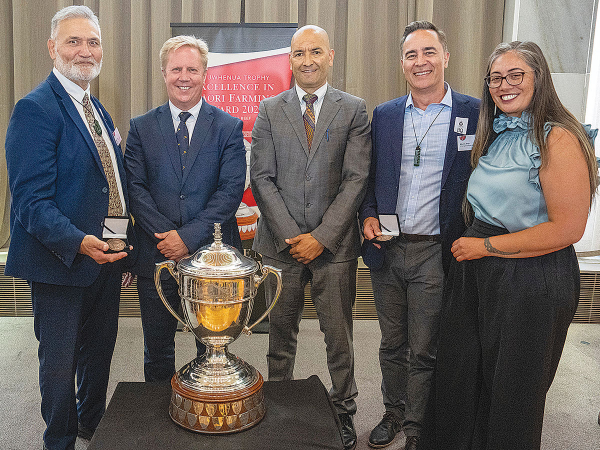 From left, Lester White, chair Tawapata South Maori Incorporation Onenui Station, Todd McClay Minister of Agriculture, Tama Potaka, Minister of Maori Development, Morris Pita and Huhana Lydon, co-chairs Whangaroa Ngaiotonga Trust. Photo Credit: Alpha Pix
Farms from Northland and northern Hawke's Bay are the finalists in this year's Ahuwhenua Trophy competition for the top Māori sheep and beef farms.
The two finalists are Whangaroa Ngaiotonga Trust from Northland and Tawapata South Māori Incorporation Onenui Station from Hawke's Bay.
The finalists were announced by the Minister of Agriculture, Todd McClay, at a function in Parliament's Beehive last week. The event was attended by more than 100 people including politicians, diplomats, Māori and primary industry leaders, the finalists and their whanau.
The Ahuwhenua Trophy is an annual award for Māori agriculture and was inaugurated in 1933 by the Māori leader, Sir Apirana Ngata and the Governor General at the time, Lord Bledisloe. The objective was and still is to encourage Māori farmers to improve their land and their overall farming performance, with an emphasis on sustainability.
On a three-year roatational basis, the trophy is competed for by Māori farmers and growers in the sheep and beef, dairy and horticultural sectors. This year the competition is for sheep and beef.
Whangaroa Ngaiotonga Trusts property is situated near the east coast settlement of Whangaruru, about an hour's drive north of Whangārei. About an hour's drive further north is the popular tourist town of Paihia. The actual farms takes up about a third of the 1,100ha of land owned by the trust and on it they finish about 1,000 bulls. There is also 297ha of forestry and 433ha of native forest and wetland.
Tawapata South Māori Incorporation Onenui Station is a Māori incorporation located at the tip of the Māhia Peninsula, Hawke's Bay. Of the 3,476ha of whenua 1,700ha is effective farmland and 836ha under a Ngā Whenua Rāhui Kawenata.
Onenui Station is a sheep and beef farming unit wintering 15,000 stock units, including 6,000 breeding ewes, 600 breeding cows, replacements, and trade cattle. The farm finishes 75% of its sheep and 36% of its cattle, with the remainder sold store. The station comprises 350 hectares of productive flats, with the balance classified as North Island steep hard hill country.
Māori Agri Power
Nukuhia Hadfield, chair of the Ahuwhenua Trophy management committee, says it is fantastic to see these excellent finalists who will add to the impressive alumni created by this award.
She says the last few years have been hard for all sheep and beef farmers around the country as they have fought to stay in business against the odds of adverse weather and lower prices, especially for sheep meat.
"Māori farmers have been among the worst affected by the adverse weather, given that many are in areas such as the East Coast of the North Island which bore the brunt of Cyclone Gabrielle and other heavy rainstorms. I live in this region and know first-hand what our communities have endured," she says.
Hadfield says Māori are intergenerational farmers, meaning that while they want to get their properties up and running as quickly as others, they are equally concerned that any such repairs will be of such good quality as to protect the land for future generations.
"A philosophy that is both practical and sensible, and one that is catching on in the wider agri-sector," she says.
Hadfield says the other encouraging news for Māori was contained in a recent MPI report which shows that the asset base of Māori collectives (trusts, incorporations and other entities but not individual farmers) has risen from $6 billion in 2013 to $19 billion in 2023. She says this data shows conclusively that Māori are a real force in the NZ economy.
The Government is backing work on a community-led water storage scheme that could irrigate up to 11,000 more hectares of the Poverty Bay flats, Agriculture Minister Todd McClay says.

A Labour-led Government won’t be bringing back the controversial freshwater rules of 2020.
It was billed as a chance for all the political parties to woo the rural vote, but question marks hang over just how effective this was.
There's been widespread support from the primary sector for the Government's announcement on changes to freshwater farm plans that come under the Natural Environment Bill, which is now set to replace the existing RMA.
The country's second largest milk processor is warning against 'complacency' during a review of competition regulations in the dairy sector.


Fonterra shareholders can begin voting on Tuesday 20 October in the 2026 Board of Directors’ election, a Co-operative Council election in one Ward, and seven Annual Meeting resolutions.
National’s pledge to introduce 19 new national standards shows the party is serious about getting Wellington out of farming, Federated Farmers says.
The National Party’s policies to make it easier to grow fresh vegetables, secure reliable water and energy and simplify farm planning are practical changes that will give growers the confidence to invest, according to Horticulture New Zealand (HortNZ).
Fonterra Co-operative Group chief financial officer Andrew Murray has resigned to take up a role outside the dairy giant.
A major move is about to get underway to improve the quality and viability of dairy beef and cattle in NZ.
Veterinarians say changes to the code of welfare for dairy cattle provides a positive foundation for improved cattle welfare across the country.

OPINION: The same mainstream media muppets that brought you Jacindamania in 2017 have been flat out pimping for the Opportunities…
OPINION: Your old mate reckons the atrocious way farmers in the UK are treated by their lords and masters in…




