
FAR Eyes NZ Grain as Dairy Supplementary Feed
Dr Scott Champion, Foundation for Arable Research chief executive, says that everyone in the supply chain had a role to play in driving the sector's long-term success.




 increase font size
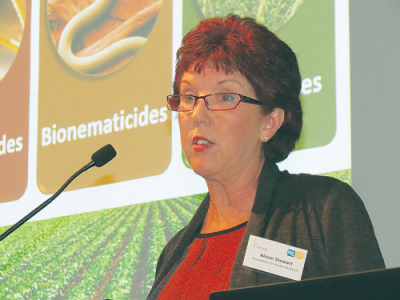 FAR chief executive Alison Stewart.
Farmers and growers need to look hard at the opportunities and benefits biological products and pesticides could bring to their businesses.
Dr Alison Stewart, chief executive of the Foundation for Arable Research (FAR), says New Zealand still uses many more agrichemicals than many other countries.
Farmers and growers should be a lot more open-minded about the way biologicals can be used and be prepared to put time and understanding into how these could integrate into their current system.
“I would like them to see how they can turn to a more environmentally sustainable way of producing their crops and create a premium product for marketing on at a global scale.”
Many biological crop protection products have been developed overseas and a few in NZ, says Stewart. She would like to see all the plant-based primary industries pick up on these products and integrate them into their intensive chemical systems.
A notable benefit of such products is that they allow growers and workers to move back into crops much sooner than when conventional pesticides are applied. “There is a huge opportunity for NZ to embrace these biological products and they provide opportunity to [promote] production systems as robust and sustainable.
“Consumers’ perception is that agrichemicals harm the environment. While not necessarily true it is a consumer perception. Growers and companies developing crop protection products have to understand consumers’ perceptions and meet their demand for products that are more natural and environmentally friendly.”
Stewart says NZ in the past took some biological products onto the market without them having been tested fully for the systems we were then operating. But now the product quality is higher and the industries know better how to use them to great effect.
Many growers and farmers understand the benefits of embracing the new biological products, says Stewart, but this is not widespread across all the sectors.
Access to high-end markets and the licence to farm are among the benefits. People selling at the high-end of the market get the value proposition that the biologics offer.
Broadacre farmers and vegetable growers may not have biological products readily available, says Stewart. “But my gut feeling is even if they were available they wouldn’t necessarily understand the value of them.”
Research running
Stewart says good long-term research into biologics is now running at AgResearch and Plant and Food. With the research comes the challenge to align it with the needs of companies and get the products registered and out there for growers to use. “We must support our burgeoning small bio-pest industry. “Overseas products are available and the large companies in NZ will start bringing those products here.”
Dr Scott Champion, Foundation for Arable Research chief executive, says that everyone in the supply chain had a role to play in driving the sector's long-term success.

Flat pricing in the face of significant increases in costs is the greatest problem facing the arable sector, says Foundation for Arable Research (FAR) chief executive Dr Scott Champion.
Four years since it was first detected in New Zealand, researchers and growers now know much more about management of maize pest fall armyworm (FAW).
Two Canadian spraying experts, Tom Wolf and Jason Deveau, are visiting New Zealand in early August to ensure that arable growers are hitting the target with this key piece of equipment.
Tickets are now available for the 2026 Arable Awards, set to be held in Christchurch on 20th August.


Safer Farms is urging farmers to make sure everyone working on farm has safe, suitable footwear for the job.

The Government is backing work on a community-led water storage scheme that could irrigate up to 11,000 more hectares of the Poverty Bay flats, Agriculture Minister Todd McClay says.
Agri-tech company Herd-i has become a new all-region sponsor of the New Zealand Dairy Industry Awards (NZDIA), the largest nationwide celebration of excellence in the dairy sector.
Four candidates have been confirmed for two director positions on Fonterra’s board.
Returning to the family dairy farm after playing 20 years of professional rugby around the world is no easy task.
After delivering another record farmgate milk price to 100 supplying farms, independent milk processor Tatua is entering thee new financial year with a positive outlook.


OPINION: The same mainstream media muppets that brought you Jacindamania in 2017 have been flat out pimping for the Opportunities…
OPINION: Your old mate reckons the atrocious way farmers in the UK are treated by their lords and masters in…




