
Federated Farmers Backs Year 11 Agricultural Science
Federated Farmers is backing Feilding High School’s call to keep Agriculture and Horticultural Science as a standalone subject in Year 11.




 increase font size
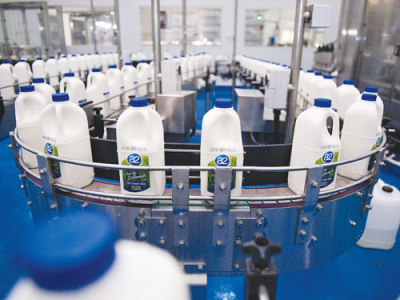 The a2 Milk Company has joined forces with Fonterra to boost sales of A2 milk in NZ and Australia.
Waikato farmers may switch to A2 milk provided there’s a suitable premium attached to the milk payment, says the region’s Federated Farmers president Andrew McGiven.
He says Fonterra’s decision to partner with a2 Milk Company to develop the A2 milk can only be a positive thing for shareholders.
“It seems to be a way to demand a premium from this milk with the A2 gene and certainly fits the co-op’s value added model,” he told Rural News.
“I think farmers in the Waikato will be keen to investigate a move to A2 milk if there is a suitable premium attached to their milk payment, and if this is a way to reduce some of the recent milk price volatility then I am all for it.”
Fonterra and a2 Milk Company (a2MC) last month signed a deal that links the co-op’s global milk pool and supply chain, manufacturing, and sales and distribution with a2MC’s brand strength and capabilities.
Fonterra will now begin talking to its farmers to develop an A2 milk pool for a2MC products in New Zealand. A similar milk pool in Australia will also be developed.
Fonterra chief executive Theo Spierings and a2MC chief executive Geoffrey Babidge say they expect to grow demand in NZ and offshore for a2MC’s products.
“The partnership is intended to fast-track market growth and this creates opportunity for our farmers to create additional value from their milk,” says Spierings.
The a2MC products will fit well in the co-op’s product range, he says.
“Consumers like to have choices and the growth of a2MC branded nutritional powders and fresh milk sales in Australia, for example, show the potential.”
Babidge says the partnership gives a2MC significant medium and long-term opportunities via “multi-site and geographic diversification and new product development”. It will give access to large scale manufacturing performance and competitive terms in a global context, he said.
“The relationship with Fonterra is the ideal model to build brand awareness and deliver a consistent high-quality product to the broadest customer base in this market.
“The opportunity to work together with Fonterra to explore new markets and products is also significant,” Babidge said.
The co-op’s resources and capability in many of a2MC’s new priority markets should help speed the distribution of a2MC products.
There are several types of casein in milk and beta-casein is the second most common.
The two most common forms of beta-casein are:
• A1 beta-casein: milk from breeds of cows that originated in northern Europe is generally high in A1 beta-casein. A1 milk comes from Holstein, Friesian, Ayrshire and British Shorthorn breeds.
• A2 beta-casein: milk high in A2 beta-casein is mainly found in breeds that originated in the Channel Islands and Southern France – notably the Guernsey, Jersey, Charolais and Limousin breeds.
Some studies indicate that A1 beta-casein may be harmful, and that A2 beta-casein is a safer choice. This is the reason for the ‘A1 vs A2’ debate.
New Zealand and Australian milk pools will support the partnership. Fonterra will talk to its farmers on the best way to source A2 milk and share the value it will create for farmers. The milk pools will expand over time.
Under a ‘nutritional products manufacturing and supply agreement’ (NPMSA) with a2MC, Fonterra will exclusively supply nutritional milk powder products in bulk and consumer packages for sale in a2MC’s new priority markets in South East Asia and the Middle East.
These products will be made at Fonterra’s NZ plants and at its nutritionals plant Darnum in Victoria.
The two companies plan distribution and sales arrangements to assist a2MC’s entry into its new priority markets in South East Asia and the Middle East.
An ‘exclusive period’ would allow Fonterra to explore a2MC branded butter and cheese, and China-sourced liquid milk for sale in Australia, NZ and China. These would be complementary to the co-op’s existing product range.
A jointly owned packaging facility will be explored under the NPMSA to cater for growth.
A NZ fresh milk exclusive licence will enable Fonterra to produce, distribute, market and sell a2 Milk fresh milk in NZ.
Federated Farmers is backing Feilding High School’s call to keep Agriculture and Horticultural Science as a standalone subject in Year 11.
Fonterra shareholders can begin voting on Tuesday 20 October in the 2026 Board of Directors’ election, a Co-operative Council election in one Ward, and seven Annual Meeting resolutions.
National’s pledge to introduce 19 new national standards shows the party is serious about getting Wellington out of farming, Federated Farmers says.
Fonterra Co-operative Group chief financial officer Andrew Murray has resigned to take up a role outside the dairy giant.
Mobile phone coverage and reliability are deteriorating in rural areas, and farming families are bearing the cost, according to a Federated Farmers survey.


Farmers are being encouraged to rethink how they manage waste on farm with the launch of ruralwastesorted.co.nz, a new website bringing together practical tips, real farmer experiences and resources.

New Zealand Winegrowers (NZW) is celebrating the India-New Zealand Free Trade Agreement (FTA) coming into force today, bringing New Zealand wine improved access to one of the world’s fastest-growing economies.
New Zealand’s red meat sector has welcomed the India-New Zealand Free Trade Agreement taking effect, which removes India’s 33% tariff on New Zealand sheepmeat.
More than 95 per cent of New Zealand’s forestry and wood exports to India can now enter tariff free as the New Zealand-India Free Trade Agreement comes into force today.
Federated Farmers is backing Feilding High School’s call to keep Agriculture and Horticultural Science as a standalone subject in Year 11.
Food and fibre exports have returned a billion- dollar bonus to the country.

OPINION: The same mainstream media muppets that brought you Jacindamania in 2017 have been flat out pimping for the Opportunities…
OPINION: Your old mate reckons the atrocious way farmers in the UK are treated by their lords and masters in…




