
Red Meat Farmers Welcome Labour's Emissions Pricing Pledge
Red meat farmers are welcoming Labour’s plan to review the Emissions Trading Scheme and not to campaign on pricing agricultural emissions.




 increase font size
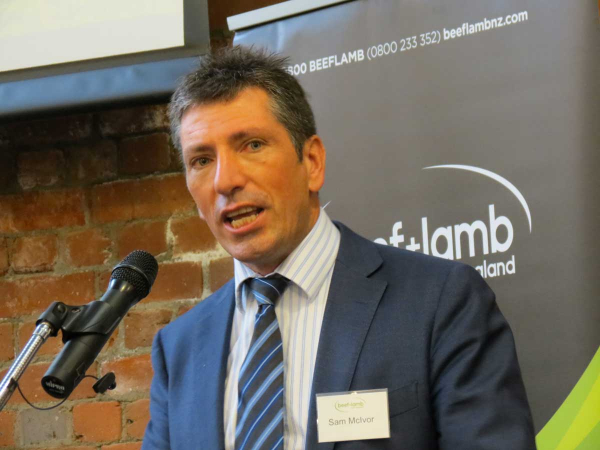 Beef + Lamb NZ chief executive Sam McIvor.
Beef + Lamb New Zealand (B+LNZ) says it is pleased by the Government’s announcement yesterday that it would boost funding for research and development into greenhouse gas (GHG) mitigation technologies.
However, the industry organisation says it is disappointed the Government has seemingly ignored the Climate Change Commission’s recommendations for forestry offset limits in the Emissions Trading Scheme (ETS).
B+LNZ chief executive Sam McIvor says the investment in the development and uptake of GHG mitigation technologies is welcome.
“We’re also pleased with the boost for R&D to better understand carbon removals in native forests, the funding for climate-focused extension and advisory services and the support for an emissions pricing system by 2025 that provides incentives for emissions reductions on-farm,” McIvor says.
However, McIvor says B+LNZ is confused as to why the Government is ignoring the Climate Change Commission’s recommendation of the need for limits on forestry offsets within the ETS, saying New Zealand is the only country to allow 100% forestry offsetting.
“The Government’s current proposals such as excluding exotics from the permanent forest category and reforms to the Resource Management Act do not go far enough. Without limits on forestry offsets in the ETS, we will continue to see vast swathes of productive food-producing farmland being converted into exotic pine plantations.
“Forestry will clearly play a role in the reduction of the country’s emissions and we support the establishment of forests as part of integrated landscapes. This is particularly important for our sheep and beef farmers, especially Māori farmers, but the Government must urgently address the unbridled ability of fossil fuel emitters to plant pine trees on productive land.”
McIvor says sheep and beef farmers have reduced GHG emissions by more than 30% since 1990 while improving productivity and generating export value for the country.
“We are the only sector in New Zealand to record this scale of achievement when it comes to reducing emissions. Furthermore, research by the Auckland University of Technology has found the 1.4 million hectares of woody vegetation on New Zealand sheep and beef farms is sucking up between 63 percent and 118 percent of our on-farm agricultural emissions,” he says.
“We are also making good progress with the Government’s He Waka Eke Noa Primary Sector Change Action Partnership to reduce primary sector emissions and enable sustainable food and fibre production for future generations. We remain committed to continuing our 20 years of substantial investment in research and innovation to reduce agricultural emissions.”
He adds that increased support for landowners to support increased forest (native and exotic) planting in the right contexts and places via advisory services is welcome.
“We also appreciate the support for better understanding the sequestration by our indigenous forests, and fairly rewarding landowners for the contribution they are making to climate change and biodiversity.
“It is vital we get a better understanding of the effects that forest management actions have on carbon removals, especially for pre-1990 forests.
“We are also renewing our calls for the Government to report on warming as well as annual emissions, which more accurately reflects our sector’s contribution to climate change, including sequestration.”
Red meat farmers are welcoming Labour’s plan to review the Emissions Trading Scheme and not to campaign on pricing agricultural emissions.
The New Zealand Institute of Forestry (NZIF) says unnecessary changes to New Zealand’s Emissions Trading Scheme (NZ ETS) will seriously erode investor confidence and result in significant reductions in forest planting rates.
New Zealand's Emissions Trading Scheme (NZ ETS) encourages afforestation while not achieving climate goals, says a new report released by the Parliamentary Commissioner for the Environment, Simon Upton.
Conversions of sheep and beef farms to forestry have slowed, however new research from Beef + Lamb New Zealand (B+LNZ) suggests land of value for food production remains at risk.
The Climate Change Commission has recommended maintaining the current New Zealand Emissions Trading System (NZ ETS) settings but warns of a potential unit shortfall as early as 2028.


Federated Farmers has welcomed new rural policies released by ACT, saying they align closely with its own election priorities.

Rural Contractors NZ says proposed changes to land transport rules for agricultural vehicles are a welcome response by the Government to out of date regulations which have seen members hit with huge fines.
Alliance is calling for final applications for its 2027 Graduate Programme, with applications closing on Sunday 25 October.
Decades piloting planes has ensured vet and farmer David Hayes is focused on safety. So, after a serious accident while welding on farm, he is sharing his experience so others can learn from it.
Canterbury milk processor, Synlait Milk has confirmed Leon Fung as its chief executive officer.
OPINION: Making it easier to collect rainwater and use it to grow crops and livestock is a no brainer.




OPINION: The same mainstream media muppets that brought you Jacindamania in 2017 have been flat out pimping for the Opportunities…
OPINION: Your old mate reckons the atrocious way farmers in the UK are treated by their lords and masters in…




