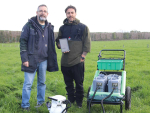
Massey Uses Portable Analyser to Measure Pasture Soil GHGs
Researchers at Massey University are using a special piece of scientific equipment to improve the measurement of greenhouse gas emissions from pasture soils.




 increase font size
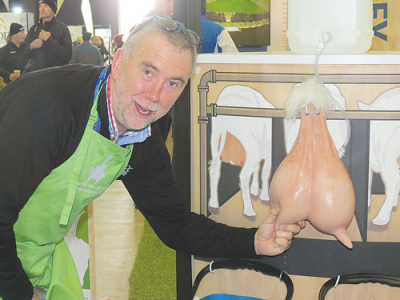 Craig Prichard.
Massey University sheep milking expert Craig Prichard’s fun exhibit at Fieldays -- allowing site visitors to milk a sheep -- had seriously optimistic intent.
Behind the fun was positive news about the rapidly growing sheep milk industry in NZ.
He noted that people have a sort of anxiety about food, prompting them to query its health properties and ponder whether it will make them feel better. People want to learn more about products made from sheep milk, Prichard says.
The sheep milk cheese industry is growing; people like the elite products. At the same, he says, they are looking at the dairy cow industry -- labelled by some a polluter -- and comparing that to the sheep milk industry which they perceive is less harmful to the environment.
Prichard says the sheep milking industry has strong relationships with farmers, the general public and customers.
“We are connecting with people. What’s more the sheep milk industry has always been about food, not about animals. NZ farmers are in the habit of continuously thinking about production rather than the food they are producing; we are trying to make a transition [from production to food thinking] via sheep milking.”
Prichard says farmers need to talk more about food and less about animals, and ditch the ‘dollars/kilo thing’.
“That sends exactly the wrong message,” he explains. “You have to think about who you are trying to communicate with and the word ‘food’ is the one to use.”
He says the food sector has to start thinking about how people will integrate its food products into their lives. Some may choose to be connoisseurs of cheese and that is great.
“Others may respond to the industrialisation of their palette by some of the big companies in the food sector.”
Prichard says the sheep milk industry is trying to show change can happen as it uses a different animal and produces different food.
Researchers at Massey University are using a special piece of scientific equipment to improve the measurement of greenhouse gas emissions from pasture soils.

Interest in agritech and production animal systems has prompted Massey University's School of Agriculture and the Environment to new majors to its popular animal science degree.
The industry is crying out for graduates with agricultural related degrees.
A four year trial has reaffirmed that mixing plantain into dairy pastures can help reduce nitrogen losses to freshwater while maintaining milk production and profitability, say researchers.
Special courses for secondary school teachers to help excite kids about agriculture and horticulture are now being run at Massey University.


LIC shareholders have elected a new North Island representative to the co-operative's Board, along with five representatives to its Shareholder Reference Group (SRG), following the company's Annual Meeting held in Invercargill.
Farmers across parts of Southland and South Otago are continuing to deal with difficult conditions after a prolonged run of wet weather, with pressure building around feed supply, stock management, pasture damage, farm infrastructure and everyday workloads.
Federated Farmers says it welcomes Labour's commitment to reviewing the Sharemilking Agreements Act, calling on other major parties to do the same.
For Canterbury dairy farmers Sian Meijer and Rick Wobben, wearable technology has become one of their most valuable on-farm tools - helping manage 1850 cows across an expansive, high-performing dairy operation while improving efficiency, mating outcomes and day-to-day decision making.
Fonterra has unveiled its annual results for the 2026 financial year, posting $27 billion in revenue and close to $20 billion returned to New Zealand farmer owners and unit holders.
The first major update to the Dairy Cattle Code of Welfare in more than a decade has been released, marking what DairyNZ describes as an important step in ensuring animal welfare standards continue to evolve alongside scientific evidence and on-farm realities.





OPINION: The same mainstream media muppets that brought you Jacindamania in 2017 have been flat out pimping for the Opportunities…
OPINION: Your old mate reckons the atrocious way farmers in the UK are treated by their lords and masters in…




