
Feds Back National’s 19 Farming National Standards
National’s pledge to introduce 19 new national standards shows the party is serious about getting Wellington out of farming, Federated Farmers says.




 increase font size
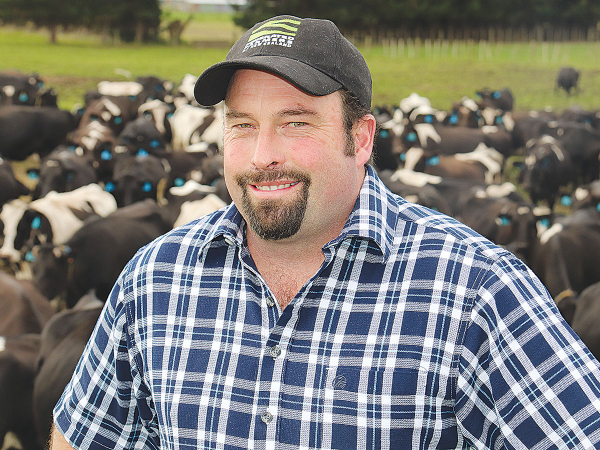 Federated Farmers dairy section chair Richard McIntyre.
There is a feeling of optimism in the dairy industry, says Federated Farmers dairy section chair Richard McIntyre.
Despite high interest rates and input costs, farmers feel things will get better, he says.
His comments came as global dairy prices recorded their fifth consecutive rise on Global Dairy Trade (GDT) auction.
Since the start of summer, prices have risen by 12% cumulatively, with last week's GDT gains being their largest gain so far. Whole milk powder and butter prices have been the big movers, rising 13% and 32% over that period.
Overall prices continue to sit at their highest since June 2023 and have lifted by around 29% since last year's low in August 2023.
McIntyre acknowledges that dairy farmers have been struggling under the burden of high interest rates, high input costs and a below breakeven milk price.
However, there is a feeling of optimism that things will get better, he told Rural News.
"Last year's general election brought in a government that has promised to resolve many of the dairy industry's concerns, although now it is a matter of ensuring that these promises are put into action.
"Interest rates appear to have reached their peak and are putting considerable strain on farmers carrying high levels of debt."
He says the rise in GDT prices in recent months has provided relief and hope for dairy farmers.
"Fonterra's milk price has already risen 75 cents since the low in August and there is talk that another rise could be on the cards."
Fonterra's forecast milk price midpoint, on Thursday last week, was $7.50/kgMS.
Westpac has lifted its forecast milk price to $7.90/kgMS, just 10c short of the upper end of Fonterra's guidance range.
Westpac chief economist Kelly Eckhold noted that the uptrend in dairy prices is interesting now that it seems to be extending into 2024.
He says Chinese consumers still appear cautious which also makes them cautious about the strength of demand in the coming year.
"But forecasts of Chinese growth have stabilised in recent months as the authorities have increasingly provided support to the economy.
"Much of this support seems more focused on the industrial sector as opposed to consumers but it may be the case that some of this support might increasingly spill over into the soft commodities we export to China."
ASB now expects farmers to get around $8/kgMS for this season.
ASB economist Nat Keall says the resilience in prices has been such that their estimate for the season's farmgate milk price continues to be "mechanically pushed higher".
"As such, we now think farmers can expect a price at or around the $8/kgMS mark.
"Increasingly, the question is whether prices can build on their current levels over the next season in the face of another year of deceleration in the Chinese economy."
National’s pledge to introduce 19 new national standards shows the party is serious about getting Wellington out of farming, Federated Farmers says.

Mobile phone coverage and reliability are deteriorating in rural areas, and farming families are bearing the cost, according to a Federated Farmers survey.
Central Otago District Council (CODC) has voted against a plan to spread treated sewage sludge from Cromwell and Alexandra on farmland near Lauder, a decision Federated Farmers says reflects strong opposition from rural residents.
Federated Farmers has called on Central Otago District Council (CODC) to drop or vote down a plan to truck sludge from Alexandra and Cromwell to farmland near Lauder, warning it would compound an "outrageous" situation created by a separate council's decision weeks earlier.
Federated Farmers says new legislation replacing the Resource Management Act will cut red tape, unlock investment and help grow New Zealand's export-led economy, after the Planning Bill and Natural Environment Bill passed their third reading in Parliament yesterday.


National’s pledge to introduce 19 new national standards shows the party is serious about getting Wellington out of farming, Federated Farmers says.
The National Party’s policies to make it easier to grow fresh vegetables, secure reliable water and energy and simplify farm planning are practical changes that will give growers the confidence to invest, according to Horticulture New Zealand (HortNZ).
Fonterra Co-operative Group chief financial officer Andrew Murray has resigned to take up a role outside the dairy giant.
A major move is about to get underway to improve the quality and viability of dairy beef and cattle in NZ.
Veterinarians say changes to the code of welfare for dairy cattle provides a positive foundation for improved cattle welfare across the country.
Today, 15 October, is the International Day of Rural Women, which recognises rural women’s contribution to farming, communities and the environment.



OPINION: The same mainstream media muppets that brought you Jacindamania in 2017 have been flat out pimping for the Opportunities…
OPINION: Your old mate reckons the atrocious way farmers in the UK are treated by their lords and masters in…




