NZKGI Responds to Migrant Worker Exploitation Reports
Where any worker in the kiwifruit industry is mistreated, we expect the authorities to take action.




 increase font size
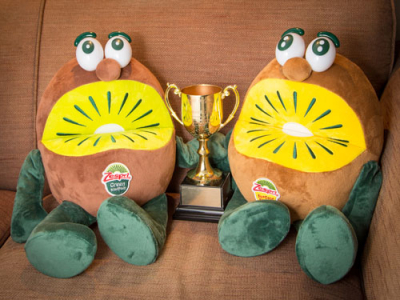 Move over celebrities, here come the two ‘Kiwifruit Brothers’.
Move over celebrities, here come the two ‘Kiwifruit Brothers’.
For Kanako Inomata, the head of marketing for Zespri Kiwifruit in Japan, the switch from celebrities to the mascots have worked wonders.
This week she was presented the New Zealand Kiwifruit Industry Innovation Trophy; an award set up in 2015 by former chairman of Kiwifruit New Zealand Sir Brian Elwood, recognises outstanding innovation achievements and this is the first year it has been presented.
Japan is Zespri’s longstanding number one market; Japanese people are bombarded by 18,000 TV commercials a year and where sales of fruit have been dropping over the past decade.
Inomata was tasked with challenging convention and introduce marketing approach in Japan that makes Zespri Kiwifruit the hero, putting it front and centre in consumers’ minds, says Zespri general manager global marketing Jiunn Shih.
“For many years, our marketing relied on using well-known celebrities to promote the product. Through her work in consumer research and insights, Kanako recognised while this had positive short-term impact, it failed to build the Zespri brand toward its potential, with consumers remembering the celebrity more than the product they’re promoting.”
Working with celebrities can also be relatively costly, while marketing budgets have limits. Responding to consumer insights, Kanako came up with an entirely new approach – two mascots called the ‘Kiwifruit Brothers’. These award-winning characters have proved enormously popular with consumers and helped increase brand awareness and resonance for Zespri in Japan.
Innovation requires more than a good idea however. Kanako’s next challenge was to get Zespri’s sales partners on board with the new programme, involving instore displays across Japan using 13,000 sets of the mascots. It was supported with an integrated animation-based TV commercial, plus communication through digital media, fruit sampling and packaging, to establish the loveable mascots as enduring, iconic characters in Japan.
“The execution of the programme has been excellent, supported by new ways of understanding consumer insights that we are now sharing with other Zespri markets. Through breaking a long-standing marketing approach, Kanako has found a way to engage with younger consumers in Japan and open up significant new potential to grow Zespri sales,” says Shih.
Japan is regarded as a mature market and has been Zespri’s longstanding number one market globally. However, Zespri was able to grow sales by 30% in this important market between 2015 and 2017 and has plans to further increase sales by 25% over the next five years. This shows that innovative marketing approaches based on consumer insights can unlock further growth potential.
The judging panel for the trophy involved Zespri chairman Peter McBride, industry regulator Kiwifruit New Zealand (KNZ) chair Kristy McDonald and NZ Kiwifruit Growers Inc (NZKGI) president Doug Brown.
Commenting on behalf of the judges, McBride said the panel reviewed some excellent nominations, showcasing a wide variety of innovation across the industry.
“Whether the innovation involves science and technology, investment models, marketing or other initiatives, the application of new ideas underpins the long-term viability of our industry. We are delighted to recognise Kanako for her excellent contribution which can create enduring value and we thank all those who have been nominated for the trophy this year,” says MMcBride.
Where any worker in the kiwifruit industry is mistreated, we expect the authorities to take action.

Kiwifruit growers are watchful but remain optimistic as concerns around the potential effects of the El Niño weather pattern this season.
More signs of a booming kiwifruit sector.
Having judged at the Japan Wine Challenge in both 2024 and 2025, I’m looking forward to returning to the role in Tokyo this October.
After delivering a strong financial year, rural trader PGG Wrightson says the coming months will depend on customer confidence and weather.


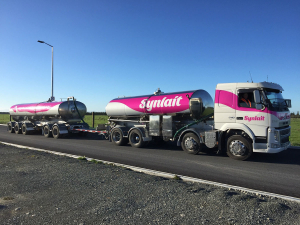
Synlait has swung to second-half profit as operations stabilise, but the dairy processor still posted a $75.4m annual loss.

LIC shareholders have elected a new North Island representative to the co-operative's Board, along with five representatives to its Shareholder Reference Group (SRG), following the company's Annual Meeting held in Invercargill.
Farmers across parts of Southland and South Otago are continuing to deal with difficult conditions after a prolonged run of wet weather, with pressure building around feed supply, stock management, pasture damage, farm infrastructure and everyday workloads.
Federated Farmers says it welcomes Labour's commitment to reviewing the Sharemilking Agreements Act, calling on other major parties to do the same.
For Canterbury dairy farmers Sian Meijer and Rick Wobben, wearable technology has become one of their most valuable on-farm tools - helping manage 1850 cows across an expansive, high-performing dairy operation while improving efficiency, mating outcomes and day-to-day decision making.
Fonterra has unveiled its annual results for the 2026 financial year, posting $27 billion in revenue and close to $20 billion returned to New Zealand farmer owners and unit holders.




OPINION: The same mainstream media muppets that brought you Jacindamania in 2017 have been flat out pimping for the Opportunities…
OPINION: Your old mate reckons the atrocious way farmers in the UK are treated by their lords and masters in…




