
Labour Vows to Change Tact on How to Handle Freshwater Rules
A Labour-led Government won’t be bringing back the controversial freshwater rules of 2020.




 increase font size
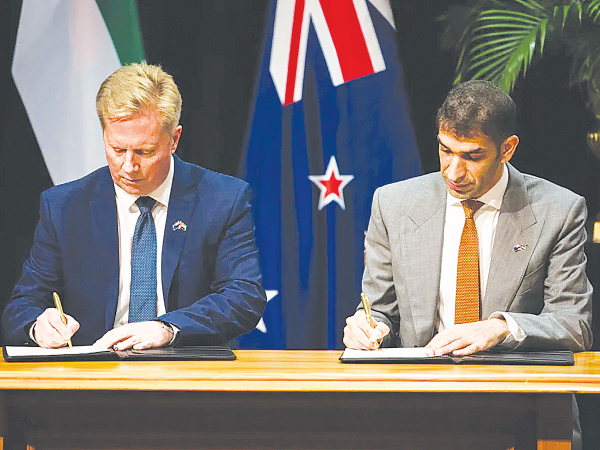 Trade Minister Todd McClay and his UAE counterpart Minister of State for Foreign Trade Dr Thani bin Ahmed Al Zeyoudi in Wellington last week.
There's been widespread praise from the primary and business sectors for the Government's speedy negotiation of a trade deal with the United Arab Emirates.
The NZ International Business Forum (NZIBF) describes the deal as a welcome bright spot which will help build further trade in the Middle East while Beef + Lamb NZ says it's a boost for hard-hit farmers.
According to Trade Minister Todd McClay, the deal - called a Comprehensive Economic Partnership Agreement (CEPA) - will unlock economic opportunities for Kiwi exporters and create stronger supply chains with one of our most important trading partners in the Gulf region.
The agreement took just over four months to negotiate and is one of the fastest agreements NZ has ever negotiated. It will see the UAE immediately eliminate duties on 98.5% of NZ exports when the deal takes effect and this will rise to 99% within three years.
"This will create new opportunities for New Zealand businesses in the dynamic UAE market, contributing to our ambitious target of doubling exports by value in ten years," McClay says.
This agreement was concluded in just over four months following the launch of negotiations on 7 May this year, making this New Zealand's fastest-ever trade agreement negotiation, and the most trade liberalising of any of the UAE's CEPAs to date.
McClay says the deal shows the Government's commitment to opening doors and reducing costs and barriers for Kiwi exporters.
"The UAE is a key export destination and hub in the Gulf region. In the year to June 2024, two-way trade was valued at NZ$1.3 billion. The UAE is one of our largest markets in the Middle East, and a top 20 export market overall," he says.
Currently NZ dairy exports to the UAE amount to $718 million, red meat $46 million and horticulture $44 million.
In addition, NZ exports $237 million in industrial products and tourism accounts for $31 million. NZ imports around $152 million of products and services from the UAE including plastics, carpets, travel services and glass.
Stephen Jacobi, the executive director NZIBF, says while the deal is called a 'Closer Economic Partnership Agreement' CEPA, it is for all intents and purposes a Free Trade Agreement.
"It's just a linguistic issue because it is a preferential trade agreement.
"It has all the elements of previous FTAs including market access and a reduction in tariffs, trade rules; all the ones we would associate with things like rules of origin, customs procedures, trade facilitation and digital economy competition," he says.
Although he hasn't seen the final text, he believes that it has chapters relating to the environment and labour. He says the issue of investment is a side agreement which is simply how the UAE prefers it to be.
Jacobi says the days of the big transformational FTAs such as those with the EU and the UK, are over but this is the type of deal we'll see more of in the future, which is still great news for NZ.
Jacobi says while such an agreement may be a basis for future deals, he says in the case of India, a deal with that country is likely to be less comprehensive than that with the UAE.
A Labour-led Government won’t be bringing back the controversial freshwater rules of 2020.
It was billed as a chance for all the political parties to woo the rural vote, but question marks hang over just how effective this was.
There's been widespread support from the primary sector for the Government's announcement on changes to freshwater farm plans that come under the Natural Environment Bill, which is now set to replace the existing RMA.
The country's second largest milk processor is warning against 'complacency' during a review of competition regulations in the dairy sector.
Agriculture Minister Todd McClay has admitted that a scheme bringing workers from Pacific nations to work on orchards has become too hard to navigate but says changes are coming.


Farmer-owned fertiliser company, Ballance Agri Nutrients is welcoming National’s plan to negotiate security agreements with key supplier countries to protect New Zealand-bound products from export restrictions and greater supply chain certainty.

Carrfields has announced the appointment of Stu Hall to the newly created role of chief operating officer, Carrfields Ltd, reflecting the continued growth of their agribusinesses and the need to ensure the company has the leadership capacity and support in place as it pursues the emerging opportunities ahead.
New Zealand's role is not to compete with Indian growers, according to NZ Apples and Pears.
The potato industry is celebrating the success of two rising stars - James Blair, the 2026 Young Grower of the Year and runner-up and innovation award winner, Amber Davy.
Twenty-eight emerging leaders from across the horticulture sector spent two days last month learning valuable skills and connecting with industry experts.
There are five entrants in this year’s Young Horticulturist of the Year, competing in a series of technical, practical, business and leadership challenges.




OPINION: The same mainstream media muppets that brought you Jacindamania in 2017 have been flat out pimping for the Opportunities…
OPINION: Your old mate reckons the atrocious way farmers in the UK are treated by their lords and masters in…




