
Lanaco and Blueair Launch World-First NZ Wool Air Filter
New Zealand wool is reaching new heights as air filtration companies move away from synthetic products to biodegradable alternatives.




 increase font size
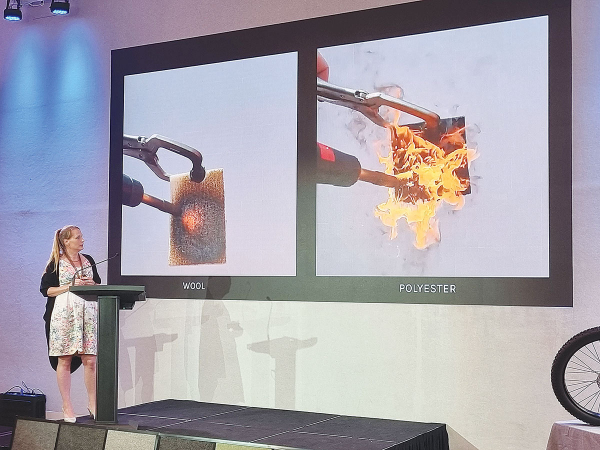 When burnt, the fire resistant Floc Panels produce little heat and less smoke than synthetic fibres.
With Government backing, a New Zealand company has successfully developed a fire resistant, acoustic wall panel for commercial interiors made entirely from strong wool.
T&R Interior Systems Limited (T&R) was founded in 1992 by Steven Thwaite primarily as a distributor. However, it has evolved to become a leader in interior solutions and R&D around acoustic and non-structural seismic systems. This interest in interior acoustics led the company into looking at wool as a material for acoustic panels.
Called Floc Panels, technical director at T&R Hedda Landreth told Rural News Floc Panels are directly fixed to a wall.
“But it’s made out of 8-10mm worth of pure strong wool. Think of it like an acoustic wallpaper.”
To meet New Zealand’s strict building and fire code standards, T&R spent two years of development and refinement in which they came up with a brand-new, patent pending process to make the wool fire resistant up to Group 1-S. This is the highest classification achievable – without sacrificing its compostable, environmentally friendly characteristics.
“Burning Floc produces little heat, produces less smoke than synthetic fibres and results in a charred state where synthetics catch light and melt away from the flame.”
Campaign for Wool NZ chair Tom O’Sullivan describes T&R Interiors wool acoustic tile product as impressive.
“I would have to say this is one of the most exciting innovations for NZ strong wool that I have seen in a long time.”
Agriculture Minister Damien O’Connor says that the panels will provide a sustainable and environmentally friendly alternative to existing, predominantly synthetic products.
“Most existing acoustic products in are imported from overseas, so it’s great that a Kiwi company has invested to create this homegrown product,” he claims. “Innovations like these will resonate in our export markets and help them maximise their earning potential.”
Landreth says the domestic acoustic wall covering market is estimated to be worth between $35-50 million annually.
“Even if we could replace half of the current synthetic market we’re talking about a massive amount of strong wool. It’s down to us to ensure we do the product justice.”
Allied Market research has forecast the global market to increase by 6.3% to US$13.8 billion by 2031.
Landreth says that, in these early days, the priority is getting the panels moving in New Zealand, then expanding to export markets.
“We’re hoping that the New Zealand wool story and the traceability and properties of wool will make it a very attractive product overseas.”
T&R was awarded $303,200 from the Ministry for Primary Industries’ Sustainable Food and Fibre Futures (SFF Futures) fund to accelerate pre-commercial development of the wool panels. The amount of wool used is expected to increase as new export markets are targeted by the product.
"This project with T&R is just one of 15 projects funded through SFF Futures to date that are aimed at re-energising our strong wool sector,” O’Connor says. “It complements our establishment of Wool Impact, which is charged with driving innovation and demand for our strong wool.”
New Zealand wool is reaching new heights as air filtration companies move away from synthetic products to biodegradable alternatives.
Will a stronger, more coordinated voice help rebuild confidence and improve returns in the wool sector?
OPINION: Confidence in the wool sector is rebounding as prices hit levels not seen in more than 15 years.
The recently signed free trade agreement with India is an invitation to strengthen relationships between the New Zealand and Indian strong wool industries, says Wool Impact chief executive Andy Caughey.
Strong competition and tightening supply have seen wool reach its highest prices paid at auction since 2011.


Farmgate lamb prices are down by 8%, beef cattle by 4.5% and farm expenditure up by 4.2%.
Kiwifruit growers are watchful but remain optimistic as concerns around the potential effects of the El Niño weather pattern this season.
Almond hulls sourced from Australian orchards may have the potential to help New Zealand cows reduce emissions, boost milk yield and lower input costs.
Striking a balance between meeting the needs of industry to speed up approval time for products but on the other hand ensuring that risks are properly assessed.
Surprised, humbled and quite thrilled. That’s the reaction of James Allen, one of the founding partners and now chief executive of AgFirst, on being made a life member of the Institute of Rural Professionals.




OPINION: The same mainstream media muppets that brought you Jacindamania in 2017 have been flat out pimping for the Opportunities…
OPINION: Your old mate reckons the atrocious way farmers in the UK are treated by their lords and masters in…