Friday, 10 June 2022 07:55

At flick of a switch

Written by  Mark Daniel
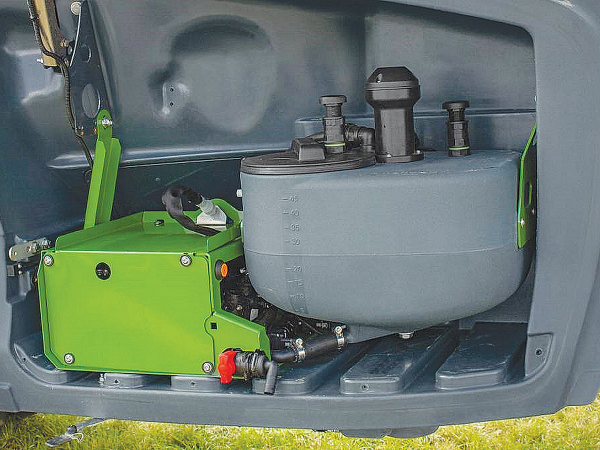
The DirectInject system allows the precise injection of specific products into the spray circuit, which can be stopped and started as required. The DirectInject system allows the precise injection of specific products into the spray circuit, which can be stopped and started as required.

Users will have more control during spraying operations with Amazone’s new DirectInject system.

It allows for the inclusion of supplementary crop protection products on the move while spraying.

Claas Harvest Centre Amazone product manager Joshua Patrick says farmers and contractors are constantly faced with new demands during spraying operations. As new products emerge and new technologies develop, farmers and contractors are increasingly asked to apply specific additional products, often to address a particular problem in a localised area of a paddock, or to refrain from spraying a specific product in environmentally-sensitive fields or bodies of water.

The DirectInject system allows the precise injection of specific products into the spray circuit, which can be stopped and started as required.

This means operators can now treat specific portions of the paddock with different agents, in just one pass – saving time and money.

The system consists of an additional 50-litre tank built into the storage compartment located on the right-hand side of Amazone’s UX 01 Super trailed spray unit. Easily filled from ground level, the tank is fitted with its own metering system and incorporates a mechanical agitator to keep the blend homogenous.

The DirectInject feed system can be used with UX 01 single-axle crop protection sprayers fitted with the AmaSwitch or AmaSelect single nozzle control and DUS pro high-pressure recirculation system.

It is activated from the cabin at the touch of a button as operators detect specific weeds that need to be controlled using the supplementary product. The layout of the system keeps the pre-mixed spray agent from the main tank separate from the supplementary plant product by using a second spray line across the boom.

Circulation of the main line is stopped when the secondary direct feed is activated, so product from the main tank is not mixed with the product from the secondary tank.

DirectInject can work with undiluted plant protection agents, allowing unused quantities to be returned to the original container.


More like this

Amazone Catros Cultivator Marks 25 Years of Tillage Innovation

With an extensive cultivation portfolio, Amazone entered a new era in tillage 25 years ago when it launched the newly developed Catros in 2001, an innovative design with a high performance, compact, shallow stubble cultivator, initially sold as a three-point linkage mounted implement.

Amazone unveils flagship spreader

With the price of fertiliser still significantly higher than 2024, there is an increased onus on ensuring its spread accurately at the correct rate.

Featured

Agri Experts Give Their Views on 2050

Despite near universal optimism in the rural sector, a panel of New Zealand’s leading food and agri minds caution that the sector must be intentional about its future path.

The panel say this is needed if the sector is to successfully

navigate the social, economic, environmental and technological forces impacting its operating environment.

Their views form part of the latest version of Rabobank’s annual white paper ‘Succession 2050 – gearing up for New Zealand’s food and agri future’.

Experts Identify Key Global Challenges

The white paper focuses on the topic of succession at an industry level.

In addition to Rabobank’s own insights, the paper brings together a selection of 14 leading New Zealand and international food and agri experts – including trade negotiators, economists, systems analysts, scientists and technologists along with sectoral experts in sustainability, the future of fibre and Māori enterprise – to share their perspectives on what the New Zealand food and agri sector could look like in 2050 and what needs to change to achieve that vision.

Launching the new paper at the Primary Industries New Zealand Summit in Auckland today, Rabobank New Zealand CEO Todd Charteris said the experts who contributed to the white paper had identified plenty of reasons for New Zealand to be confident about its food and agri future.

“To name just a few, we’re a major food producer in a food-hungry world that’s on track to need 56% more food by 2050,” he said.

“Our food and fibre exports are also growing strongly and are forecast to hit $64.3 billion for the year to June 2026, while our government has signalled its plans to help double overall New Zealand exports by 2034.”

While there were many reasons for optimism, Charteris said, the expert contributors had also noted a host of changes taking place across the global food and agri operating environment that would need to be navigated for the industry to achieve ongoing success in the decades ahead.

“A number of key changes shaping the future of the sector came through in the perspectives of the expert contributors,” he said.

“There are the well-canvased issues of increasing global food insecurity, the challenging trade environment driven by geopolitical tensions, and the need to produce food within planetary limits."

'Identity Eating' Emerges as a Key Consumer Trend

“However, the experts also raised emerging trends, including what we’ve called ‘Identity eating’ – which is the growing way of signalling who you are as a person through what you eat – and is leading to higher demand for ethical and health-conscious foods.

“Another key trend identified out to 2050 was ‘Exponential everything’, which covers the transformation of the sector through science and technology.”

Rather than let these changes wash over it like a tsunami, Mr Charteris said, the broadly held view among the expert contributors was that New Zealand’s agriculture sector would need to lean in and proactively shape the changes occurring around it.

“We heard this message in many different ways; whether it was influencing global trade policy, embracing technology, capitalising on sustainability, training up for the future, defending our advantage in dairy or kiwifruit, growing Māori enterprise or more deliberately utilising all the wealth in our big blue backyard,” he said.

Building a 2050 growth engine for food and agri

Charteris said the white paper contributors had identified 23 changes they would like to see in New Zealand between now and 2050 that will help set up the sector for success.

“Essentially, they boil down into five buckets with four to five ‘work ons’ in each bucket,” he said.

“At the centre, we need a change model that starts from the customer perspective and works outward from that, feeding into more purposeful decisions about land use and production systems.

“Then once we are clear on what customers are asking for and where we want to play, we need to stack talent and technology.

“Between these items we have the elements of a 2050 growth engine.”

What’s exciting, Charteris said, is that New Zealand has the geography, the capacity, the ideas, and the time, to make something outstanding of its future.

“My wish is that our experts’ thinking will inspire others to join me in pushing for a more deliberative strategic future for New Zealand,” he said.

Government Mulling Plan Change 1 Intervention

The Government is looking at intervening on behalf of Waikato farmers who face new regulations around agricultural land use while Resource Management Act (RMA) reforms are underway.

National

Machinery & Products

» Latest Print Issues Online

The Hound

Great Idea!

OPINION: Central Hawke's Bay farmer Mark Warren recently told the Hawke's Bay Times it's time for a conversation about allowing…

No Choice

OPINION: A nation that relies as heavily as NZ does on functional global shipping lanes will have to do its…

» Connect with Rural News

» eNewsletter

Subscribe to our weekly newsletter