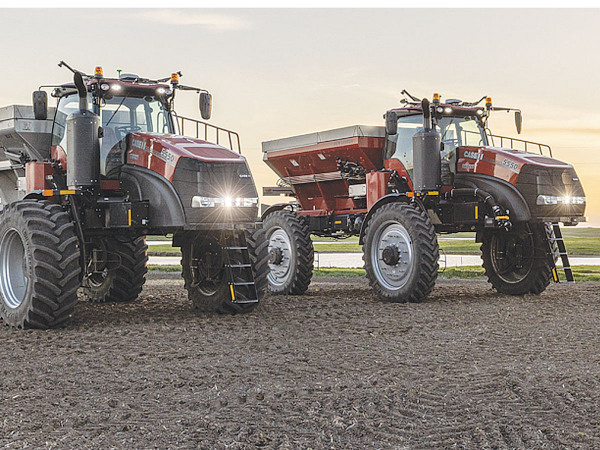
Case IH has partnered with Raven Industries to launch the Trident 5550 applicator, understood to be the agricultural industry’s first autonomous spreader.
Aimed at a market looking to solve the challenges of labour shortages and the need to improve efficiency, the Trident 5550 applicator combines proven Raven Autonomy driverless technology with an agronomically-designed spreading platform for a flexible autonomous solution. Raven uses its proprietary software to control guidance and steering, speed control and path planning.
In operation, likely using a mobile device, operators can plan and complete the spreading function based on mapped field boundaries. Using a series of advanced cameras and a radar system, the Raven Autonomy system constantly senses a 360-degree environment around the machine looking for obstacles and motion initiation while operating. A perception controller processes the continuous stream of images, which interprets and detects obstacles, with a link back to the remote operator to view the cameras at any time.
If an obstacle is detected, the machine will safely come to a stop and an alert will be sent to the operator’s mobile device. At this point, the operator can evaluate the situation and determine the next course of action.
Additionally, a range of machine tasks and functions can be viewed remotely. These include fuel and DEF levels, vehicle speed, hopper levels, Universal Terminal information and diagnostic fault codes.
This latest innovation follows on from the Case IH autonomous concept vehicle launched in 2016. It comes after research found autonomous spreading was an operation that customers would likely adopt.
The Case IH Trident 5550 allows for one or more driverless machines in the paddock without an operator present. However, it also provides the flexibility of full control inside should it be required.
By operating at a constant speed and with precision, the autonomous applicator should provide spreading consistency – with human error removed – and allow for repeatable performance with centimetre accuracy.
“This is a significant milestone in our accelerated product development efforts between Case IH and Raven,” says Scott Harris, Case IH global brand president. “It highlights our intense collaboration and robust product innovation following CNH Industrial’s acquisition of Raven in late 2021.”