Claas Balers Turn 30
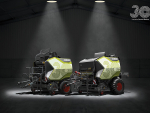
Claas built its first variable chamber round baler - the Variant 100 - in 1996, so 2026 marks 30 years and the fifth generation of the Variant name, recently complemented by the new Cerex Series introduced in 2025.




 increase font size
 Claas has updated its range of Orbis maize headers.
Claas has updated its range of Orbis maize headers, adding the Orbis 450 which shares many features initially introduced on the larger Orbis 600SD and 750 units.
With a 4.5m working width, the unit incorporates the new tilting frame concept and redesigned T panels which help reduce weight and increase wear resistance.
Newly designed fingers ahead of the knives ensure low-loss crop collection and have points which can be removed for harvesting laid maize. The new knives have a crescent-shaped blade which delivers top cutting quality in all crops.
The central crop feeding tower rotors have been repositioned to improve crop flow and angled forward to aid crop feed. They are also spaced wider, so increasing the feed channel to allow crop to be fed into the full width of the feed rollers and chopping cylinder. Augers at the edge of the Orbis help feed the crop into the header in poor conditions. These are driven hydraulically.
The new roller pendulum frame concept has lifted the crop flow to the centre of the Jaguar’s precompression rollers, improving crop even at full oscillation in uneven fields. The frame also handles the weight of the unit better and allows adjustment of the mounting angle, to regulate the header angle when the machine is travelling over softer ground.
The new frame also helps provide a shallower cutting angle, giving the benefit of a much shorter stubble height, allowing crops to be cut at less than 100mm stubble height if required.
Under the header, newly designed modular T-panels support the drive train and the discs.
The T-panels are press hardened and rounded, dimensionally stable, wear resistant and protect the transmission elements against wear and structural loads.
For road transport, the new Orbis 450 rapidly folds down to just 3.0m, offering an unhindered view, and an integrated communication module transmits data from the front attachment to the forage harvester. This saves Jaguar settings for subsequent use, even if removed then reattached.
Claas built its first variable chamber round baler - the Variant 100 - in 1996, so 2026 marks 30 years and the fifth generation of the Variant name, recently complemented by the new Cerex Series introduced in 2025.
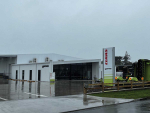
At a time when many businesses are taking a cautious investment approach, Landpower continues to back its customers, having officially opened the doors to its new CLAAS Harvest Centre dealership in Feilding, marking a significant investment in the future of agriculture across the lower North Island.
Twin rotor swathers have become the ‘go-to’ for forming swaths to feed hungry harvesters and balers, however, the design layout often means that crop located between the two rotors is not picked up, turned over or incorporated into the swath formed for subsequent harvesting.
Fifty Eight years ago, on the 16th of August 1968, August Claas, the founder of the harvesting company and father of Helmut Claas, personally presented a Claas Senator combine harvester to Scottish farmer John Steven.
Scheduled to replace its Axion 800 series, Claas has released details of the new, three model, Axion 8 CMATIC range.



During the nesting season, from September to December, industrious starlings can quickly build nests in the darker areas behind tractor and vehicle, usually close to hot engines, typically resulting in localised damage or in some cases complete write-offs.
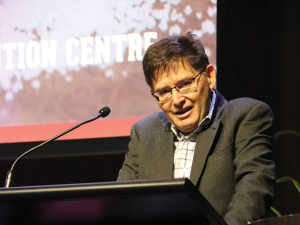
The meat processing industry is much more collegial than it was in the past and is now more focused on common goals.
With the last couple of months having seen some potential tractor purchases put on hold with the impending election and continued input cost rises, year-to-date figures, ending September, has seen deliveries up around 5% over the same period in 2025, with a total of 2026 units.
Beef+Lamb New Zealand is calling for nominations for director roles in the Northern South Island and Northern North Island electoral districts.
Fonterra chief executive, Richard Allen says being resilient has helped the dairy industry overcome extreme volatility in recent years.
The head of the Ministry for Primary Industries (MPI) trade and international relations group says New Zealand is well-positioned to secure trade access and compete internationally as the world becomes more complicated, demanding and uncertain.



OPINION: The same mainstream media muppets that brought you Jacindamania in 2017 have been flat out pimping for the Opportunities…
OPINION: Your old mate reckons the atrocious way farmers in the UK are treated by their lords and masters in…