Pichon Adds SV10R and SV14 to SV Slurry Tanker Range
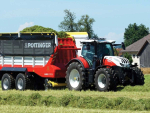
French manufacturer Pichon has expanded its SV slurry tanker range with the launch of two new models.




 increase font size
 What’s the correct bolt to use in a particular situation?
You cannot go far in farming without encountering fasteners such as nuts and bolts, given that expensive plant, machinery and buildings are held together by them and your gates would not fill gateways if they were missing.
It’s a sure bet that every farm workshop will have a bucket, drawer or bin with a wide selection of new or used nuts and bolts, but what’s the correct bolt to use in a particular situation?
Fasteners have a basic code or a language that needs to be understood depending on the application, for example, fastening a heavy gate hinge doesn’t require the same qualities as that of a fastener holding a piece of rotating machinery.
Metric fasteners are classed using the ‘ISO’ (international Standards Organisation) designation.
A mild steel cup head, typically known as a coach bolt and its corresponding nut, will be ideal for that gate hinge on a gate hinge, with the benefit of being a hot dipped galvanised product (HDG) that will last for an exceptionally long time.
However, looking more closely at agricultural equipment, the original fasteners are purposely made to do the job safely, so rummaging in the “odds and sods” bucket to find a replacement that is not the same grade as the original could lead to a catastrophic failure.
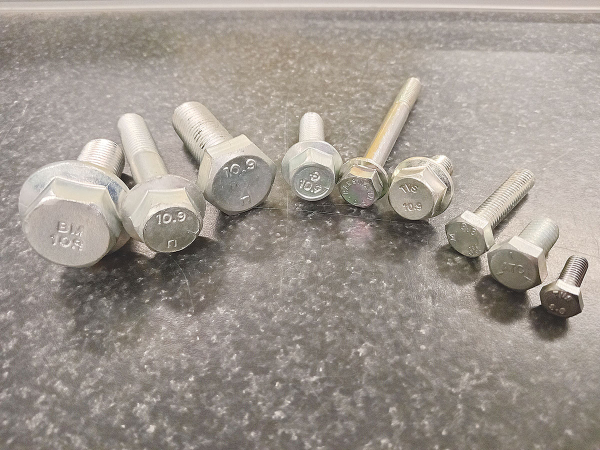
To identify the strength of a fastener, the head of the bolt will be blank or stamped with numbers. A blank bolt head, or the numbers 4.6 or 4.8, will indicate ‘mild steel’. A high tensile, typically used in demanding applications, will typically start with an 8.8 marking and depending on the application move upwards through 10.9 and 12.9 indicators.
So, what do these figures mean? The first digit is the ‘tensile’ strength of the fastener, strength in megapascals x 100 (e.g. mild steel = Class 4.6 and high tensile = Class 8.8,10.9,12.9 etc).
The second digit is the fastener’s ‘yield’ point; being a percentage, e.g. a number including ‘.8’ equals 80% of the original tensile strength when an applied force takes the fastener from an elastic state to a plastic state.
In basic terms, the fastener is “stretched” or “yields” when under load, to the point that it cannot return to its original state and breaks.
Class 4.6 & 8.8, etc refers to ‘Metric’ fasteners, however ‘Imperial’ UNC, UNF and other thread forms, are referred to as Grades. The fastener industry groups ‘non-metric’ fasteners into the Imperial category as measurements are based on the imperial inches system.
The American Society of Automotive Engineers, (SAE) created a similar system to metric, but instead of using numbers, uses dashes to identify the base material, its hardness range and strength of a fastener.
The Imperial identification method uses radial lines stamped on the bolt head, with no markings identifying mild steel, with three or more lines signifying high tensile steel. Correspondingly, nuts have identifying notches and dots to suit their equivalent bolts.
In NZ, to avoid any issues, the majority of Black or Zinc plated nuts will be high tensile items, the exception being HDG nuts, which are tapped over- size to offer extra clearance when used with a thicker galvanised bolt thread.
Looking at Imperial fasteners, most imperial fasteners sold in New Zealand will be Grade 5 (High Tensile) or higher, except for a bolt with as BSW (British Standard Whitworth) profile or similar. BSW is sometimes called a ‘dead’ thread, typically sourced via a specialist supplier for those customers undertaking a vintage restoration project.
Batten Buddy
Lloyd Altham is a lifestyle farmer with a past career in engineering and the fastener industry. Frustrated by fencing battens slipping laterally, he set about designing, manufacturing and testing the Batten Buddy over five years.
The result is a patented fastener that when hooked over a 2.5mm high tensile fencing wire and screwed to the batten, ensures the batten is held securely in place.
www.battenbuddy.co.nz
French manufacturer Pichon has expanded its SV slurry tanker range with the launch of two new models.
Recently revealed, Krone’s new Series Six, BiG Pack Plus and Pro balers are designed to use standardised components, interfaces, and control concepts, including pick-up, knotter systems and user interfaces.
Consuming around six years and more than 35,000 hours of physical and digital testing, the new sixth-generation Valtra T Series is being described as the most significant new release in the company’s history.
Strautmann has introduced a new Hay Edition auger for its Verti-Mix feed mixer wagons, aimed at operators using rations with larger proportions of hay or other long-fibre materials.
Twin rotor swathers have become the ‘go-to’ for forming swaths to feed hungry harvesters and balers, however, the design layout often means that crop located between the two rotors is not picked up, turned over or incorporated into the swath formed for subsequent harvesting.


National’s pledge to introduce 19 new national standards shows the party is serious about getting Wellington out of farming, Federated Farmers says.
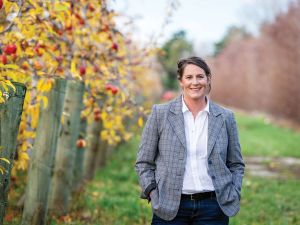
The National Party’s policies to make it easier to grow fresh vegetables, secure reliable water and energy and simplify farm planning are practical changes that will give growers the confidence to invest, according to Horticulture New Zealand (HortNZ).
Fonterra Co-operative Group chief financial officer Andrew Murray has resigned to take up a role outside the dairy giant.
A major move is about to get underway to improve the quality and viability of dairy beef and cattle in NZ.
Veterinarians say changes to the code of welfare for dairy cattle provides a positive foundation for improved cattle welfare across the country.
Today, 15 October, is the International Day of Rural Women, which recognises rural women’s contribution to farming, communities and the environment.




OPINION: The same mainstream media muppets that brought you Jacindamania in 2017 have been flat out pimping for the Opportunities…
OPINION: Your old mate reckons the atrocious way farmers in the UK are treated by their lords and masters in…




