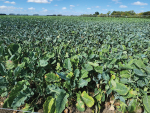
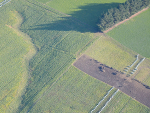
Winter forage grazing is used extensively in the South Island as a low-cost system to feed dairy cows and build body condition prior to calving in late winter.
However, the practice is recognised as having a large potential for nitrate leaching loss from heavy urine deposition, especially in the free-draining soils of Canterbury. Most winter forage paddocks are left bare or fallow prior to pasture renewal or sowing of another fodder crop in late spring/summer. But with nitrate leaching losses from these wintering systems - measured at any thing from 50-180kg N/ha annually - reducing leaching is important for ground and surface water quality.
Sowing a catch crop after winter forage grazing is one way to take up some of this deposited urinary-N and can reduce N leaching losses by as much as 40-50%. Now in the third year of a three-year MPI Sustainable Food and Fibre Futures (SFF Futures) project, researchers from Lincoln Agritech and Plant and Food Research have shown that sowing catch crops on commercial dairy farms during winter is not only possible, but profitable - with few downsides.
Lincoln Agritech and Plant and Food Research conducted six research trials in Canterbury from 2018-2019 - across three commercial dairy farms in winter forage paddocks at Te Pirita, Hororata and Mt Somers. Trials compared tillage method (direct drill vs. minimum till), crop species selection (Italian ryegrass, triticale or oats) and crop mixes (oats vs. oats/Italian ryegrass).
The oats drilled at Te Pirita trial (Intimidator - Luisetti Seeds) produced a high-yielding 12t DM/ha green chop silage crop after only five months, but importantly, took up over 200kg N/ha. Indeed, most catch crops of oats in Canterbury yielded 8-10t DM/ha if sown by early August, with N uptakes ranging from 100-200kg N/ha.
This nitrogen resource might otherwise have been lost and farmers could use it more efficiently, having already effectively paid for it. Gross profit margins (before harvest costs) typically ranged from $1400-$2550/ha ($0.25 c/kg DM standing feed). This more than compensates for the small loss in crop yield if sowing another fodder crop like kale.
However, a note of warning, catch crops need monitoring and a judicious application of N fertiliser (40kg N/ha) in late spring might still be required to achieve optimum silage quality and quantity if the crop starts to show the first signs of N deficiency.
Catch crops aren't limited to oats. Tritiscale, for example, was an option for those looking at whole crop silage but oats, being more winter active, tended to get away quicker. Italian ryegrass was also trialled alone but wasn't as high-yielding as the cereals.
However, an oats/Italian mix, was found to be a good option for speedy pasture renewal of a winter forage paddock after the main oats crop has been harvested - providing further grazing or baleage over the summer.
Importantly, soil mineral N was significantly reduced by the catch crops.
Catch crops as expected, reduced available soil mineral-N but the soil under the fallow (bare soil/no crop-red circle) increased by 50% over the same period. We can also assume that some of the mineral N under fallow or bare sol is likely to have moved below this depth so the true increase may well be more than 50%.
Dr Peter Carey is a field research scientist at Lincoln Agritech Ltc.
Key Messages
Early establishment of a cereal crop, even in winter, is the key to success.
Oats has proved the most robust and reliable catch crop for Canterbury with DM yields in late November (green-chop silage) ranging from 8-12tDM/ha.
Direct drilling the catch crop is preferred but minimum tillage may be required on badly pugged paddocks to help prepare a suitable seed bed.
Soil mineral-N can be variable after grazing so monitor the N status of the catch crop to ensure maximum yield and quality.
Mixes with Italian ryegrass (using oats) have been fund to be a good combination for those wanting to speedily re-grass paddocks after harvest.
Give it a go! - Everybody's farm is different but somewhere in your winter forage rotation there is likely an opportunity for you to experiment and introduce a catch crop into your system.