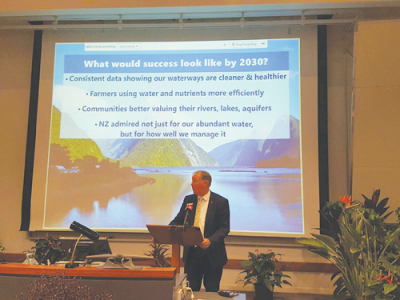
Environment Minister Nick Smith recently outlined the Government’s objectives on freshwater management. Here are excerpts from his speech given as part of the 2016 Lincoln Environment lecture.
The number one objective is to improve freshwater quality; it is too important to our quality of life, national identity and economic wellbeing to allow it to go backwards.
The second objective is maximising the economic opportunity for jobs and wealth creation from our freshwater resources.
The third objective is to improve the involvement of Maori in freshwater decisionmaking, consistent with our Treaty settlements and obligations.
Some people question the objective of improving Maori participation in freshwater management, but the obligation arises not only from Treaty settlements.
My practical experience in Canterbury with Ngai Tahu, in Waikato with Tainui, in Lake Taupo with Tuwharetoa and in Rotorua Lakes area with Te Arawa is that iwi bring a constructive and helpful dimension enabling real momentum to improve our freshwater.
Water issues often come down to a clash of values between environmentalists and land owners. Maori have a foot in both camps and are proving to be valuable bridge builders over these troubled waters.
We can achieve the first and second objectives stated above.
Some people are dualistic about our nation’s water choices: they insist on either water quality or growing the economy. We disagree. We clearly need limits, and not all irrigation projects, for example, will pass sustainability tests. But many water projects can deliver both environmental and economic dividends.
Let me reinforce this point with three examples.
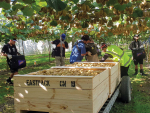
Few people appreciate that water storage and irrigation can enable land use changes that actually reduce nutrient run-off. The Lee Valley dam in Nelson will enable about 2000ha of dry-land farm to be converted to horticultural crops. Irrigated apple orchards leach substantially less nitrate than the existing farming.
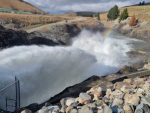
Water storage projects can also enable higher minimum flows in summer, as has become obvious in the Opihi River in South Canterbury with the Opuha scheme. Enhanced minimum flows improve the ecological health of rivers, enhance recreation and can reduce nutrient concentrations and the risk of algal build-up. A further benefit is that water storage schemes can be used to prevent the build-up of harmful algae with high freshening flows.
The ultimate big opportunity for water storage projects to contribute positively to water quality is particularly pertinent to Canterbury. Ninety per cent of the water in Canterbury is in the big alpine rivers, but the bulk of the huge water takes for irrigation are from the groundwater and vulnerable lowland rivers. The infrastructure costs to farms of storing and using the alpine river flows is much greater, but the environmental impacts and ongoing energy costs can be much less. One of the difficult public policy challenges is to engineer this switch from groundwater to stored alpine river water.
We have six clear policy views on how we can best deliver on these improvements in freshwater management.
The first is that stronger national direction is required. My first job as an undergraduate civil engineer was with the National Water and Soil Conservation Authority in Canterbury, just before its abolition in 1987. The view then – which dominated public policy for 20 years – was that the regional authorities could do the job.
The problem with this approach was it ignored the broader national interest: it wasn’t efficient to re-litigate the same issues 16 times over, and regional councils have struggled to confront the hard political choices concerning water.
We have sought to step-up central government involvement a few notches. We have expanded the number