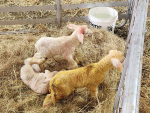
Beef + Lamb NZ's Lambing Kit Checklist for a Tough Season
With lambing underway in many regions, Beef + Lamb New Zealand is encouraging farmers to put together a wellequipped lambing kit to help minimise lamb losses, particularly in bad weather.




 increase font size
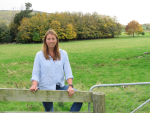
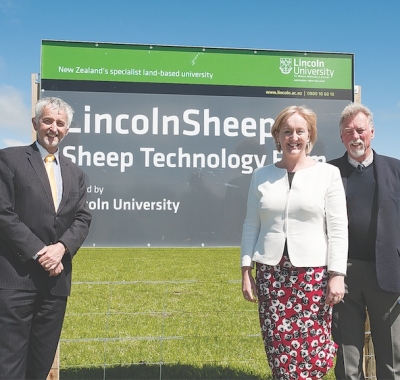 Dr Andrew West, Amy Adams, Prof. Tony Bywater
DONE RIGHT, sheep farms can compete with dairy, says Professor Tony Bywater, of Lincoln University’s faculty of agriculture and life sciences.
Bywater’s comments were made when local MP Amy Adams officially opened Lincoln University’s sheep technology farm (LUSTF) earlier this month.
Sited on the 21ha former South Island Field Days site, LUSTF will be used for student and farmer training, field days, demonstrations and research.
Bywater says Lincoln’s sheep research division, LincolnSheep, is focussed on two main farm types: summer safe or summer dry and, with LUSTF, use of irrigated finishing blocks.
‘’The true opportunity cost of an irrigated lamb finishing block is not what you might get running a dairy farm; it is what you get on your dry land breeding farm if you don’t have one.”
Putting irrigation onto a finishing block to increase sheep numbers costs about one third of a dairy conversion, which, with nitrate levels under scrutiny, may not seem as attractive as it once did, he suggests.
LincolnSheep will also research ewe ‘elasticity’, using a CT scanner to measure body fat and protein relative to weight through the year, and hormone treating ewes to lamb more than once per year.
Work to identify more efficient ewes in terms of weight of lamb weaned is also planned. That could mean big differences in productivity ‘’without doing anything else,” says Bywater.
Selective drenching – not treating animals with no evidence of parasitic infestation – and the power of electronic tagging as a management tool are also on the agenda.
Lincoln University vice-chancellor Dr Andrew West says the intention is to scale up LincolnSheep’s findings at the Lincoln-Westoe Trust’s 400ha drystock training and demonstration farm at Westoe, Rangitikei.
The farm was transferred to the trust earlier this year by Jim and Diana Howard who gave Lincoln University exclusive use of the property to help train the next generation of farmers.
The Howards’ generosity and vision was recently acknowledged with the inaugural Lincoln University vice-chancellor’s award.
West says the farm is a ‘’gift to the nation’’ and will be used as a training and demonstration sheep and beef farm. The Westoe homestead, with nationally significant gardens, will be used for horticulture and arboriculture courses.
Howard says he won’t have to worry about fixing fences at Westoe anymore, but he will still garden around the homestead and, as a member of the trust, will keep a “close eye on the place”.
West notes there is no such sheep and beef demonstration farm nationally and says the Westoe farm will be ready for such a role in less than two years.
With lambing underway in many regions, Beef + Lamb New Zealand is encouraging farmers to put together a wellequipped lambing kit to help minimise lamb losses, particularly in bad weather.
Will a stronger, more coordinated voice help rebuild confidence and improve returns in the wool sector?
The vineyards at Pyramid Farm in Marlborough’s Avon Valley have never been run of the mill, with plantings that follow the natural contours of the land, 250 metres above sea level.
Sheep and cattle numbers continue to decline, and this year's drought hasn't helped, according to Beef + Lamb New Zealand (B+LNZ).
High quality feed, reduced stocking rates and shelter will all help enhance triplet lamb survival and ultimately benefit the bottom line.


New Plymouth-based Manuka honey exporter Egmont Honey has completed its acquisition of Taihape beekeeping business Tweeddale's Honey, with settlement finalised on Friday, 18 September.

Westpac NZ is calling on farmers and growers to start preparing now for the possibility of a dry summer, as likely El Niño conditions raise the risk of drought across parts of the country.
Fonterra Co-operative Group has confirmed the independently assessed candidates standing for election to its board in 2026.
Fonterra has revised its Farmgate Milk Price forecast for the 2026/27 season, lifting the midpoint and narrowing the range on the back of improving global dairy commodity prices.
New Zealand's citrus growers were challenged to build their future on the value embedded in their fruit rather than the volume they produce, at Citrus New Zealand's annual gathering in Gisborne on 17 September.
Leading John Deere technicians and apprentices from New Zealand and Australians were recognised at the recent sixth annual JD Technician of the Year Awards, held in Brisbane.




OPINION: The same mainstream media muppets that brought you Jacindamania in 2017 have been flat out pimping for the Opportunities…
OPINION: Your old mate reckons the atrocious way farmers in the UK are treated by their lords and masters in…




