
FAR Eyes NZ Grain as Dairy Supplementary Feed
Dr Scott Champion, Foundation for Arable Research chief executive, says that everyone in the supply chain had a role to play in driving the sector's long-term success.




 increase font size
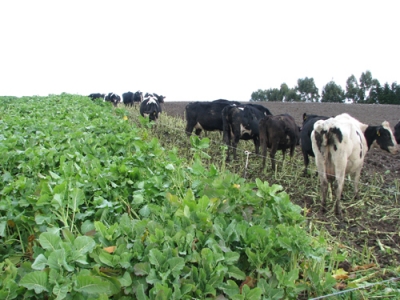
Cropping farmers are being urged to consider the true cost of winter grazing to their businesses.
During a series of grower workshops in recent weeks the Foundation for Arable Research (FAR) has outlined best practice and highlighted potential pitfalls.
“We’re looking at the whole farm system and brassica and fodder beet are an increasingly important part of what cropping farms are doing,” FAR’s Ivan Lawrie told one of the workshops.
Even in 2009, 30% of arable farms were growing such forage crops for dairy grazing or finishing beef or lambs on, and that percentage “has grown substantially in the last five years,” he says.
“Traditionally this wasn’t our space but we felt it was falling between the cracks…. There wasn’t any integration between the three levy organisations getting information on these crops out to everybody.”
Now, partly with Government funding, the organisation is working with other sector bodies to develop best practice guidelines and put numbers on the impact of various winter grazing techniques on subsequent crops. “That’s not been easy to do,” notes Lawrie’s colleague Diane Mathers.
Initial work has identified some evidence of compaction in winter grazed areas compared to non-grazed. Soil bulk-density tests taken pre- and post-grazing towards the end of winter on seven farms by FAR found a range of 1.08 to 1.36 before grazing to 1.15 to 1.48 after, where untouched soil would be 1.0 and severely compacted 1.4.
“You can rip the soil but it’s not going to fix that [bulk density] problem overnight,” says Lawrie.
Mathers says the wet-weather compaction reduces soil aggregate stability, impairing rooting and increasing risk of run-off and erosion. “Obviously if we’re going to wreck our soils we’ve got a bit of an issue.”
Some farms have reported yield impacts on following crops as much as three years after a severe winter grazing event, but there’s been no scientific study to establish how severe or how widespread such incidences are. “Perhaps that’s one of the areas we need to put work into,” adds Mathers.
Faster results of soil mineral nitrogen tests following grazing would also help growers account for residual fertility when applying fertiliser to following crops, she notes.
“You get denitrification in cold wet soils so there may not be as much there as you think. And heaven help us if we ever get back into talking about emissions because that’s another loss farmers will get hammered with.”
Losses through drainage may also be considerable: Mathers noted that at one workshop an Environment Canterbury representative said about half the nitrogen lost on arable farms comes from “that little bit of dairy grazing”.
Managing winter grazing risk
Dr Scott Champion, Foundation for Arable Research chief executive, says that everyone in the supply chain had a role to play in driving the sector's long-term success.
Beef + Lamb New Zealand is reminding farmers with lucerne stands to graze them hard over the next few weeks in preparation for a winter weed control programme.
Southland farmers are being encouraged to get ahead of the winter grazing season by attending a practical field day in Pukerau next week.
Farmers wanting to establish subterranean clovers in their pastures this autumn are encouraged by Beef + Lamb NZ to graze pastures down to 700-1000 kg DM/ha prior to sowing.
Animal welfare is of paramount importance to New Zealand's dairy industry, with consumers increasingly interested in how food is produced, not just the quality of the final product.


Farmer-owned fertiliser company, Ballance Agri Nutrients is welcoming National’s plan to negotiate security agreements with key supplier countries to protect New Zealand-bound products from export restrictions and greater supply chain certainty.

Carrfields has announced the appointment of Stu Hall to the newly created role of chief operating officer, Carrfields Ltd, reflecting the continued growth of their agribusinesses and the need to ensure the company has the leadership capacity and support in place as it pursues the emerging opportunities ahead.
New Zealand's role is not to compete with Indian growers, according to NZ Apples and Pears.
The potato industry is celebrating the success of two rising stars - James Blair, the 2026 Young Grower of the Year and runner-up and innovation award winner, Amber Davy.
Twenty-eight emerging leaders from across the horticulture sector spent two days last month learning valuable skills and connecting with industry experts.
There are five entrants in this year’s Young Horticulturist of the Year, competing in a series of technical, practical, business and leadership challenges.


OPINION: The same mainstream media muppets that brought you Jacindamania in 2017 have been flat out pimping for the Opportunities…
OPINION: Your old mate reckons the atrocious way farmers in the UK are treated by their lords and masters in…




