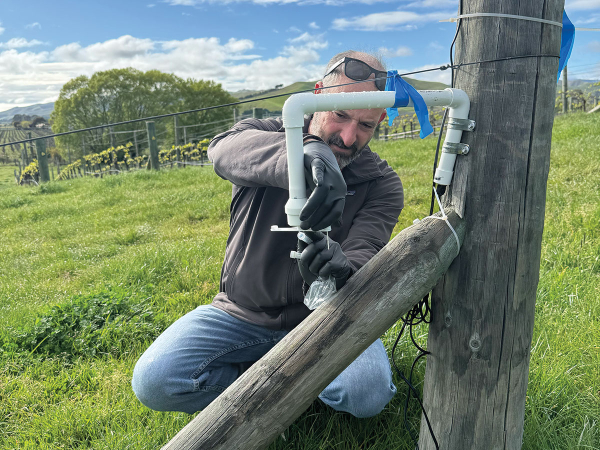
A powdery mildew spore trapping trial could significantly reduce early season spraying in New Zealand vineyards, cutting costs and environmental impact.
Thoughtful Viticulture is running the trial with support from several vineyard operators, and placed traps in Gisborne, Hawke’s Bay, the Wairarapa, Central Otago and Marlborough in the lead up to the growing season.
Similar spore trapping trials in Oregon indicated growers were spraying too early, enabling them to drop more than three spray rounds a season on average, says Thoughtful Viticulture owner Dr Mark Krasnow. “I think we can get a similar result here, which would be a game changer for both the economics and sustainability of growing grapes in New Zealand.”
Viticulturist Karen Peterson was involved in the Oregon trial, led by “the powdery mildew guy” Dr Walt Mahaffee. She says the New Zealand trial will help identify resistance to QoI, SHDI, and DMI fungicide, and enable growers to make informed decisions around their spray programmes. “New Zealand has experienced a shift in powdery population in the last 10 or so years that flipped the script on how people had to manage powdery mildew,” says Karen, noting that the relatively “new” industry standard spray practice is driven by the experiences and challenges of the past. “We believe that it’s time to challenge the status quo with tried and true tools that have worked in other countries.”
Using simple spinning traps sourced from SARDI in Australia, Karen and Mark obtain spore counts from USDA in the US, and map them against weather conditions, to gain insights into a vineyard’s risk of powdery mildew under various parameters. “We’re also testing the well-established powdery risk model against site specific conditions in relation to spore load and powdery mildew threat to validate the model’s usefulness here, and hopefully provide growers with yet another tool to assess risk,” Mark says.
Their ultimate goal is to have access to qPCR (Quantitative Polymerase Chain Reaction) in New Zealand, in order to quantify the spore DNA in real-time. But in the meantime, support from growers, and collaboration with researchers at SARDI and the USDA is enabling them to gather key data, Mark says. “Spore samples we’ve received to date appear to support our hypotheses, but we’re looking forward to seeing more data from all of the regions, and reporting back this winter.”