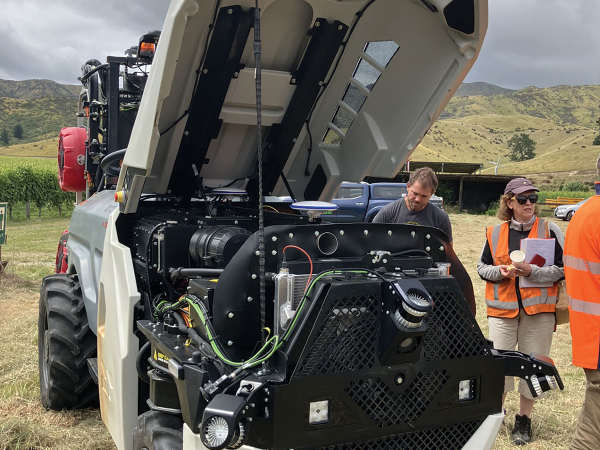
Watched by growers and wine industry representatives from across Marlborough and beyond, the relentless march of the Prospr modular vehicles from Tauranga-based Robotic Plus was part of a demonstration day held by Treasury Wine Estates (TWE) at one of its Matua vineyards.
While the technology was undoubtedly impressive, the mood among the gathered growers was practical. Given labour shortages, rising fuel costs and sustainability targets looming large, for many growers the question was not whether vineyard automation would ever arrive, but how quickly it could solve the real-world problems they face.
The introduction of vineyard robots also aligns with the New Zealand Winegrowers Roadmap to Net Zero 2050, which identifies reduced diesel use and improving operational efficiency as critical industry priorities. Indeed, TWE’s goal for the demonstration day, organised in partnership with NZW and EECA (Energy Efficiency and Conservation Authority), was to share valuable insight into how automation can support workforce transition, improve day-to-day operations, and advance the wine industry’s shared sustainability goals. “We’ve created a wine-specific decarbonisation pathway, which basically means a bunch of free tools and resources to help businesses in the wine sector save money and be more energy efficient,” said EECA’s Richard Briggs. “It’s working with the industry. It’s customised for the industry.”
NZW General Manager Sustainability Dr Edwin Massey said those were important conversations, and having more than 40 people attend the demonstration shows that autonomy is a huge part of the future. “And the future is today.”
Changing Demographics
Beyond the novelty of watching driverless vehicles ply vine rows is a deeper story about the changing nature of the viticulture sector. Charlie Halliday, National Grape and Wine Sourcing Executive for TWE, argued that the introduction of AGVs was not about removing jobs, but rather about reframing roles to appeal to a younger demographic. “If you look at the demographics, it’s going to be harder and harder to find people wanting to sit on machinery. I think it’s inevitable that we’ll need some form of automation there. So rather than sitting on a sprayer for hours and hours, you’re now potentially someone who’s managing two or three of these machines from a base shed or some other location.”
Charlie’s team has been working closely with Robotics Plus as part of a trial across three of TWE’s Marlborough vineyards, focusing initially on spraying and herbicide application. The early signs are encouraging, with fuel use dropping by around 70%. Ben Harris, TWE viticulturist, said the trial was already demonstrating productivity and sustainability gains, with opportunities to extend autonomous functions across up to 150 hectares. Edwin explained that diesel emissions are a big part of what the industry needs to change. “The diesel efficiencies we heard about today – 1.5l per hour versus 9l or 10l with a tractor – shows the benefits that these kinds of machines can have.”
Read More:
According to a December release from EECA, the trial supports TWE’s global commitment to net zero Scope 1 and 2 emissions by 2030. In 2025, TWE also installed a 210 kW rooftop solar array at their Matua Valley winery site in Marlborough as part of that commitment. Technology trials like the one at TWE are most effective when they follow a clear optimisation-first approach, Richard said. “Just simply automating something that’s already inefficient isn’t the right way to go. Optimise first, get that production right, and then if you feel that you still need to do that function, then by all means, go and automate it.”
Live Long and Prospr
Robotics Plus publicly launched the Prospr AGV in 2023 and has since focused on utilisation and flexibility, with its modular architecture allowing for different tools to be used in various applications year-round, thereby maximising return on investment. The vehicle turns on its rear axle, requiring a minimum headland of 7.1m/23ft for row-to-row turning, which the company says allows operators to cover ground faster, maximising productivity and spray time compared to machines that turn on every second row or more.
Matthew McKinley, Product Manager for Robotics Plus, stated that the company was focusing on single row spraying but also exploring over-row capability and various other vineyard tasks.
The aim is for Prospr to evolve over time into a versatile platform that can perform spraying, mowing, plucking, and potentially yield assessment, ultimately becoming a true everyday vineyard vehicle. As the technology matures, machines like Prospr are expected to collect vineyard data as they work – supporting smarter decisions on everything from pest management to yield forecasting.
In 2025, Japanese manufacturer Yamaha Motor acquired Robotics Plus to form Yamaha Agriculture, in a major validation of the technology. The roadmap is for the Prospr platform to be combined with advanced data analytics to support growers in New Zealand, Australia, and North America, linking autonomous machinery with precision insights to further improve efficiency, reduce inputs, and enhance overall sustainability.
Marlborough‑based Smart Machine has emerged as New Zealand’s other key vineyard automation developer, with its OXIN autonomous tractor now in commercial use and being positioned for global markets through international partnerships.
Return on Investment
While New Zealand is now playing a leading role in the development of vineyard robotics, the widespread adoption of such vehicles will ultimately depend on demonstrable cost-effectiveness, along with the cultural shifts required for autonomous machines to be integrated into vineyard operations.
At the Prospr demonstration day, TWE representatives said the return on investment metrics were still being assessed as part of the ongoing trial. Matthew said the sweet spot was likely to be one operator controlling four or five machines simultaneously, which would then make the ROI equation “really sharp”.
Automation in viticulture isn’t just about replacing tractors. Bragato Research Institute’s UV-C robot trial aims to reduce fungicide use for Marlborough Sauvignon Blanc, while Lincoln and Canterbury University researchers are testing 3D flower-scanning robots for yield prediction.
Globally, rising disease pressure is fuelling interest in non-chemical and precision control methods. In 2023, producers in regions such as Tuscany reported crop losses of up to 70% due to mildew outbreaks, underscoring the urgent need for more resilient vineyard systems. These initiatives signal that vineyard robotics is rapidly expanding – from disease control to data capture, from heavy work to smart support.
Importantly, those behind the technology say the barrier to entry is lower than many growers expect. “It doesn’t take a lot of training,” one Robotics Plus representative told growers at the demonstration day. “After four or five days, people are happy to go on their own.” With major producers trialling autonomous systems, research institutions pushing the boundaries of what robots can do in the vineyard, and global players backing New Zealand-developed technology, the direction of travel is clear.
While automation will not replace the skill and judgement of vineyard teams, it is increasingly set to become one of the core tools supporting modern viticulture in New Zealand.