Nina Downer - Young Viticulturist of the Year
Growing up on a Taranaki dairy farm, Nina Downer was accustomed to the isolated and repetitive nature of her parents’ work, milking at dawn 365 days of the year.




 increase font size
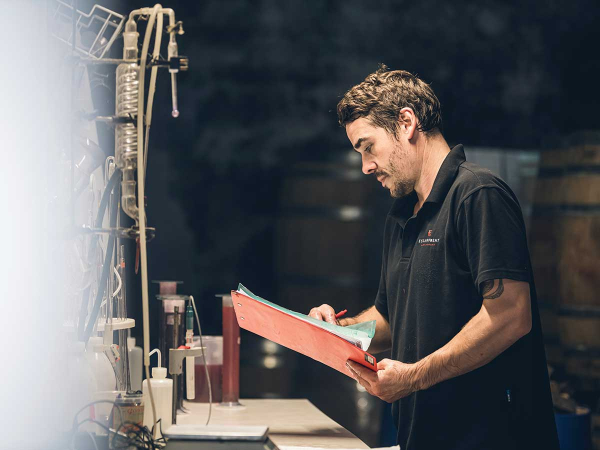 Tim Bourne at Escarpment
From the biggest wine region in New Zealand to one of the most remote corners of Western Australia, Tim Bourne’s wine career has been characterised by expecting the unexpected.
To say he stumbled into wine is a tad misleading, but he’s the first to admit he didn’t plan that career while at university.
When his visa expired during an 18-month trip to the United Kingdom between 2007 and 2008, Tim returned to New Zealand to find a job. It was then that he realised he’d developed a bit of a thing for wine. “It seemed kind of cool and interesting... I still didn’t know what a vintage was, but I knew I wanted to find out more and see if I liked working with wine.”
With harvest looming, Tim secured a laboratory job at Delegat in Marlborough and “everything clicked”, he says. “The mix of physical work and stimulating work to think about ticked the boxes for me so I enrolled part time at the Eastern Institute of Technology to complete a postgraduate diploma over two and a half years.” He continued to work at Delegat while studying, then travelled to the southwest tip of Australia to work at Plantagenet. “I found myself in a region producing Cabernet, Pinot Noir, Chardonnay, Riesling and Syrah across varied climates. It was exhausting due to the vast range of grape varieties and their ripening window, so it took significantly longer to complete vintage than it had in Marlborough.”
It was also formative, exposing him to winemaking from cool hill sites close to the ocean, and the associated influence on flavour. When vintage was over and he returned to New Zealand, Tim moved around the South Island with his girlfriend (now wife) Lace, who had taken a liquor licensing job in Queenstown. Chilly winter days in the vineyard at Chard Farm were a learning curve, but it was tough finding regular winemaking, so Tim and his young family moved to Tanunda in the Barossa Valley, South Australia.
His first job was at Two Hands for the notoriously difficult 2011 vintage, and he later joined Sons of Eden, where he worked with co-founder and co-owner Corey Ryan, who was previously Villa Maria’s head winemaker. Vintages were long there too, stretching from February to May. Grapes arrived in waves, beginning with early season Tempranillo and Shiraz from warm sites in the Barossa Valley followed by Riesling mid season and late ripening Shiraz from the cooler Eden Valley. Cabernet played a small role, arriving late. “I learnt a lot and was really shaped by Corey’s philosophy,” Tim says. “In a region where many producers followed Max Schubert’s hot, short pump-over ferments, Corey leaned toward Burgundian and Rhône-influenced methods with no racking, long, slow and cool ferments, and a focus on finesse rather than power.”
He loves Barossa Shiraz and the region’s “extraordinary old vines”, but after four years, they decided to head home. Tim was in an unrewarding role at Pernod Ricard in Marlborough, with plenty of desk time, when he applied for the Escarpment winemaker role. “Much to my wife’s horror, I was offered the job. Knowing such opportunities rarely appear, I really wanted it, especially the chance to work alongside Escarpment founder Larry McKenna.”
The family moved to Martinborough and Tim took up the role in August 2018, not long after Barossa Valley winery Torbreck acquired the winery. He worked with Escarpment founder Larry McKenna through the 2019, 2020 and 2021 vintages and then stepped into Larry’s shoes when he left in April 2022.
The acquisition of Escarpment gave Torbreck the chance to fill a natural gap in its wine portfolio, Tim says. “Torbreck bought Escarpment because this was a chance to bridge the gap between Burgundy (with its ridiculously high prices) and high level Pinot Noir. Their fine wine knowledge has been invaluable and they leave day to day operations to the Escarpment team.”
The past five years have been a rollercoaster of vintages in terms of style, thanks to unseasonal rain and unexpected cyclones. The opportunity to produce top wines from some of the most challenging vintages yet known in the Wairarapa has formed Tim’s approach to Pinot Noir from the region. “The most difficult so far has been 2022 for wineries like Escarpment, based in Te Muna Valley. Strangely, while 2023 was better in Te Muna Valley, it was worse around Martinborough village and across the Wairarapa.” The 2024, to be released next year, is his favourite vintage since joining Escarpment.
Te Muna Valley is approximately nine kilometres east of Martinborough village and more elevated but with a variation in elevation from the north to southern end of the valley. This means it can be significantly windier and mornings tend to cooler, resulting in a later harvest date, typically, than around the village. With Torbreck’s support, the brand has been able to employ the benefits of extended barrel ageing to nearly two years (effectively two winters) before bottling at the start of the following summer.
Since taking the winemaking helm, Tim has pulled back on whole-bunch fermentation so that the latest vintage of Kiwa has no whole-bunch component, Pahi has 6% and Kupe 30% – the lowest ever for this wine. “Kiwa usually suits whole bunch, while Pahi is already fleshy and silky. Kupe retains some whole bunch for structure and complexity.” Te Rehua, the only Escarpment wine from a vineyard in town – the only block not owned by Torbreck – was made in 2024, but whether a 2025 edition will be produced remains undecided. If it’s not, the grapes can potentially find their way into Escarpment Pinot Noir – a blend of grapes from across Martinborough.
Chardonnay and Sauvignon Blanc are the most important whites at Escarpment but they are dwarfed in scale by Pinot Noir. “Chardonnay from the Te Muna Valley has become a quiet star, doubling over the past three to four years thanks to new grower fruit, including clone 548 from Redbank and fruit from south of Martinborough,” Tim says. “The style is crisp and textural.”
Escarpment Sauvignon Blanc (20% barrel fermented, 5% new oak) is now in its third vintage and mostly destined for the United States where it’s a useful gateway to introduce new consumers to Escarpment’s Pinot Noirs. “The goal is texture, not overt oak.”
Tim sees Martinborough as an underrecognised gem internationally, giving it a great opportunity. “The presence of major investors – Foley, Torbreck and others – signals the region’s potential.”
Growing up on a Taranaki dairy farm, Nina Downer was accustomed to the isolated and repetitive nature of her parents’ work, milking at dawn 365 days of the year.
Martinborough’s wine industry is known for its small size and big profile, but three of its best-known wineries have significant expansion plans.

OPINION: As I approach three months in my role as New Zealand Winegrowers Chief Executive, one message has come through…

OPINION: The United States wine market has changed forever, and companies cannot use same old playbook, said Erin Kirschenmann at…
One of Australia's most decorated winemakers will speak at the Aotearoa New Zealand Chardonnay Symposium in Hawke's Bay this September.
The third Aotearoa New Zealand Chardonnay Symposium will be underway in Hastings, Hawke's Bay, on 17-18 September.
Vintage 2026 yielded excellent fruit for most New Zealand wine regions.