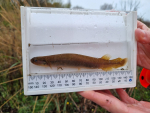
Waterway restoration sees return of endangered mudfish
A critically threatened endemic freshwater fish found only in Canterbury has been discovered at a Craigmore Sustainables farm near Timaru.




 increase font size
 Craigmore Sustainables chief executive Che Charteris.
Corporate farmer Craigmore Sustainables now has total assets of more than $1 billion, according to its 2023 Impact Sustainability Report.
Founded in 2009, Craigmore is the largest diversified rural investment company in New Zealand and its mission is to bring capital into New Zealand's rural economy to produce quality food and fibre, in a way that benefits rural communities, local ecosystems and the wider climate.
Craigmore is now managing 60 properties across New Zealand, with total sector assets of $1.011b - 35% in horticulture, 36% in farming and 27% in forestry.
A total of 25,906 hectares, including leases and forestry right areas,are now under the company's direct management.
Farming is Craigmore's most mature business, managing 22 milking platforms and one dairy support grazing farm in the South Island, producing 79 million litres of milk annually.
As well as majority-owned properties, it has five minority interest investments in dairy farming businesses that comprise an additional 8216ha producing 90 million litres of milk annually. "Over the past 12 months, Craigmore has built steadily through investing and operating land-based productive businesses to become a leader in sustainable food and fibre production," says Craigmore chief executive officer Che Charteris.
"We achieve that through investing in land-use change and in better ways of operating, which take into account some of the major challenges facing society including climate change, loss of biodiversity, and social inequity.
"This year, we have planted 1.36 million forestry trees, 860,000 apple trees, 140,000 kiwifruit vines, and 491,000 grape vines."
Craigmore is also pursuing productivity and sustainability gains through improving everyday production systems. It was set a goal of achieving an independently verified and commercially viable net zero dairy farm by 2035.
Aotearoa New Zealand's pasture-based dairy sector can produce among the lowest GHG-intensity dairy products in the world," says Charteris.
"We are focused on reducing emissions further. In addition to ongoing changes to reduce GHG-intensity of food production, we have invested in a developing methane-busting treatment that has the potential to eliminate up 90% f the methane emissions from cows, and installed EcoPond, a first-of-its-kind treatment that that virtually eliminates methane emissions from cattle effluent ponds."
Craigmore continues to create employment opportunities, supporting the commitment to growth of rural comnmunities across the country. It now has 229 direct employees and, as a key player in rural communities, employs seasonal workers and contractors.
It has also developed a network of strong partnerships which Charteris says has been critical to successfully operating in the face of extreme weather events.
"Our teams have been able to respond admirably to address damage from flooding and erosion. To be climate resilient, we need resilient teams. Our ability to respond to property-specific crises is aided by our scale, diversification and networks of talented partners.”
To date, Craigmore has also placed 2816 hectares of native forest under some form of additional legal or physical protection. It has enhanced these areas with 202 hectares of native planting, and protected a range of waterways throughout its properties.
Results from its biodiversity programme this year have included a large increase in Kiwi sightings at Wiroa kiwifruit orchard in Northland, and critically threatened endemic mudfish observed in a restored waterway on Somerset dairy farm in Canterbury.
“Our vision is to be ‘Kaitiaki – Growing the best of Aotearoa New Zealand’,” says Charteris.
“We strive to be locally, nationally and globally recognised as one of the best managers of natural assets.
“To achieve this, our businesses must deliver long-term financial returns and address industry challenges which are barriers to more sustainable futures for our communities.”
A critically threatened endemic freshwater fish found only in Canterbury has been discovered at a Craigmore Sustainables farm near Timaru.

Farm and forestry operator Craigmore Sustainables is growing its horticulture presence with two recent apple orchard acquisitions.
Craigmore Sustainables has added to its viticulture portfolio with the purchase of a 418-hectare development site in Marlborough.
Craigmore Sustainables says it is committed to investing in professional and career development for its farm managers and employees.
Under its innovation strategy, Craigmore Sustainables says it is collaborating with new innovators of technology across sustainability, people, animals and business management to enhance New Zealand's dairy sector.


Farmer-owned fertiliser company, Ballance Agri Nutrients is welcoming National’s plan to negotiate security agreements with key supplier countries to protect New Zealand-bound products from export restrictions and greater supply chain certainty.
Carrfields has announced the appointment of Stu Hall to the newly created role of chief operating officer, Carrfields Ltd, reflecting the continued growth of their agribusinesses and the need to ensure the company has the leadership capacity and support in place as it pursues the emerging opportunities ahead.
New Zealand's role is not to compete with Indian growers, according to NZ Apples and Pears.
The potato industry is celebrating the success of two rising stars - James Blair, the 2026 Young Grower of the Year and runner-up and innovation award winner, Amber Davy.
Twenty-eight emerging leaders from across the horticulture sector spent two days last month learning valuable skills and connecting with industry experts.
There are five entrants in this year’s Young Horticulturist of the Year, competing in a series of technical, practical, business and leadership challenges.



OPINION: It seems Canterbury processor Synlait is still in the doldrums.
OPINION: Get offside with New Zealand First leader Winston Peters at your own peril.




