Taking part were Nga Kaitiaki O Nga Wai Maori (NKONWM representing seven local hapu), the Integrated Kaipara Harbour Management Group (IKHMG) and the Northland Regional Council’s Mangere stakeholder catchment group.
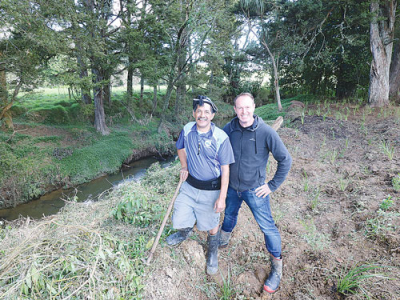
The event, attended by Kelvin Davis, MP, a Ngapuhi, had Kokopu School students plant 400 native plants on a dairy farm on the banks of the Mangere River. The plants were the first of 4000 donated to properties in the catchment.
NKONWM chair Hona Edwards says a range of karam, flax, cabbage tree, kānuka and mānuka plants were donated by Te Arai Nursery.
“This is the first planting event of this scale by NKONWM and we are positive of its success now and for any future opportunities,” says Edwards.
“Riparian planting is important on many levels, as is building supportive community relationships for success.”
Year 5-8 Kokopu School students got involved in the planting through Soozee McIntyre of Whitebait Connection who organised the 45 children, teachers and parents to do the planting on the 93ha dairy farm of siblings Shayne and Charmaine O’Shea.
“It’s important to NKONWM and the Kaipara Harbour Management Group that we find farmers willing to participate; 10 of the 18 dairy farmers in the catchment took up the offer of donated plants,” says Edwards.
DairyNZ catchment engagement leader Helen Moodie is on the catchment group working to improve the water quality of the Mangere River, and worked with local farmers to get 3000 plants onto dairy farms.
Although the Mangere, which flows into the Wairua River and Kaipara Harbour, was among the worst of Northland’s monitored rivers in the past, recent trend analysis showed this is no longer so. In fact, in 2014 the catchment won a prestigious NZ River Award for being the fourth-equal most improved river nationally.
“Dairy farmers play a key role in community projects, and riparian planting on farms will contribute to improving local waterways,” says Moodie.
“DairyNZ water quality scientists say keeping stock out of water and having grass filters or native plantings along streams helps improve water quality.
“Scientific work has shown it results in significant reductions in waterway contaminants, especially sediment and E. coli that have been identified as key issues for Northland’s waterways.”
NKONWM aims to improve water quality and fish habitat, increase fish stocks and build community relationships. Hona says this planting will help with all this by mitigating against sedimentation and providing habitat for native fish and their food supply, freshwater insects.
Along with the 4200 at Kokopu, the remaining 16,000 plants went to properties in Akerama, Whakapara, Ruatangata and Poroti. It is seen as an annual event, says Hona.