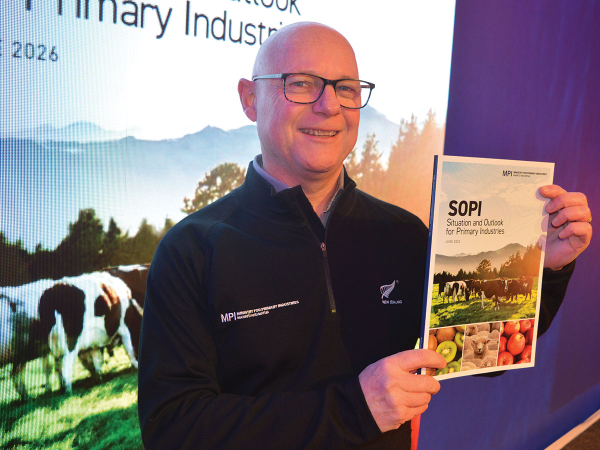
Dairy continues to be the mainstay of the country's primary export earnings.
In the year to the end of June, Ministry for Primary Industries (MPI) is predicting that export returns from our cows and dairy farmers will be $28.6 billion - up 5% on last year's record earnings.
Dairy exports now make up 47% of our total primary exports and nearly a third of our total exports.
MPI Forecasts Dairy Export Earnings to Top $31 Billion by 2030
According to MPI's latest Situation and Outlook Report for Primary Industries (SOPI) report, dairy earnings will be over $31 billion by 2030. And according to the director-general of MPI, Ray Smith, the sector has the potential to grow even more.
Smith says there is still a lot of land in NZ that hasn't achieved its productive potential and says that the Government's latest $2.6 million initiative to foster greater land-use flexibility - will spur this along.
This programme aims to focus particularly on Māori landowners to increase the productivity of land by using a combination of science, technology and regulatory reform and introducing better farming methods.
Smith says there is a lot of land that can produce higher returns by using better genetics, technology in the form of wearables and utilising pasture better.
"I think we have a long way to go in regard to this," he says.
Milk Production Expected to Ease Next Season
The SOPI report says that while there have been a couple of good seasons, the next year will see a slight drop in returns, but this will pick up in the following three years.
An example of this is milk solids.
In the past year they topped a record 2.02 billion, driven largely by favourable climate conditions and strong financial incentives.
But tighter margins and a predicted El Nino dry season will likely see milk solids fall slightly.
MPI says with that, export prices will be mixed due to a range of reasons.
Global Milk Supply Will Continue to Influence Prices
The SOPI report says the global milk supply picture remains a central driver of dairy prices and the outlook for 26/27.
It notes for example that milk production in the USA rose 3.3% in the past year and that the cow herd in the US has risen and is 9.62 million - the highest it's been since the 1990s.
At the same time, EU milk production as also rebounded, says the report.
Export Revenue Growth Outpaces Volume Growth
Perhaps one of the more fascinating facts to emerge in the report is that although our dairy export revenue was up by 5%, this was achieved by just a 1% increase in export volumes.
During the year, the biggest growth in individual dairy categories came in butter, AMF and cream - and cheese was up there too.
WMP also performed well with export revenue up by 11% to $9.1 billion.
As for the future, MPI is predicting a farmgate milk price payout of $9.85/kgMS.
But again, this comes with the warning that the Middle East crisis will place upward pressure on key farm inputs such as fuel, fertiliser and freight costs.
Positive Outlook
Smith says the situation is far from doom and gloom.
He says consumers worldwide are searching for high protein foods and that's why he believes that dairy production in NZ will continue to grow.
He says the other thing working in the favour of our dairy industry is that our cows are largely grass-fed - unlike other countries that produce and export dairy products.
"Another positive for NZ is that we've invested heavily in reducing the emissions profile of our animals, meaning we have one of the lowest environmental footprints in the production of methane by animals. That I think is going to give us a strategic advantage over the next few years and I am proud of what we have done in that respect," he says.
But Smith says while New Zealanders take for granted the sustainable production systems we operate, he's not sure that the rest of the world is fully aware of this.
"I think that we still have to do more to make sure the world knows the good news about how we farm," he says.