Fonterra Expands Organic Dairy Programme Into South Island
Fonterra has announced it will continue with the planned expansion of its organic business into the South Island.




 increase font size
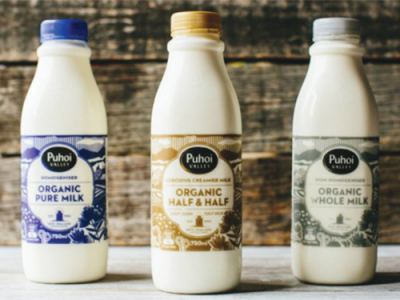 Demand for organic dairy products is rising.
With 66% of Kiwis now buying organic food, prospects for organic producers look ever more promising, comments real estate firm Bayleys.
The company refers to a recent Organic Aotearoa market report on a strong shift by consumers to organics, for which the domestic market is now $250 million – up 45% in four years. Of the $240m of organic exports last year, fresh fruit and vegetables were the largest by value – $108m.
Bayleys national country manager Simon Anderson says every aspect of protein, fruit and vegetable production offers opportunities for strong returns. And farmers and investors have growing interest in properties suitable for conversion to organics or already organic-certified.
“The highest earning organic crop is kiwifruit which accounts for about 20% of all organic exported produce,” Anderson says. “The SunGold organic fruit is premium, with insufficient supply to meet demand.”
Organics Aotearoa NZ reports a 346% increase in food sales globally since 2000; total sales are now US$80 billion.
And more land is going into organic production – about 1% of the world’s farm land. Australia has the largest area (17m ha), and Europe has 11m ha, or about 10% of its farm area in organics.
NZ has 74,000ha in organics – about 0.5% of the farmed area, averaging $33,000/ha in gross export earnings last year.
Organics Aotearoa chief executive Brendan Hoare says in the past 20 years the infrastructure to support the organic sector has grown. For example, growers once had to make their own organic fertiliser, but now certified manufacturers offer products and treatments.
Hoare says organics has grown more sophisticated because of large European and US corporates buying into established family owned organic brands.
In NZ, interest in organic dairying has risen recently, especially because Fonterra has said it will pay North Island organic suppliers $9.20/kgMS – at least double the anticipated price for the season.
The global market for organic dairy products is expected to grow 12% a year, says Organics Aotearoa NZ. This is off a base that represented 11% of total global dairy sales in 2013; the bulk of sales were in Denmark (24%), Sweden (12%) and the UK (7.5%).
China and India are seen as key growth areas for organic dairy products.
NZ sales have been growing rapidly, with a reported 50% increase in organic sales of milk in the past year.
And the Organic Dairy Hub Co-op (Dairy Hub NZ) is forecasting payment of $8/kgMS for the coming season to suppliers.
Dairy Hub founder Bill Quinn says the cooperative is keen to expand its supplier base into the South Island, and finds farmers keen to talk.
“We are working with 30 larger farmers in South Canterbury and North Otago on the transition process to organic; the interest is there.”
Fonterra has announced it will continue with the planned expansion of its organic business into the South Island.

Dairy Women’s Network (DWN) has announced real estate company Bayleys will be the naming partner for its 2025 conference.
The sale of the land and buildings that formerly-housed the Mars Petcare New Zealand facility in Whanganui closes one chapter of the region’s manufacturing story but opens another.
Running an organic dairy farm is a bit like living on an island where one has to be completely self-sufficient.
Fonterra's record payout for organic milk reflects the value of being certified organic, according to Brendan Hoare, Buy Pure NZ managing director.

A New Zealand initiative supporting farmers to restore the health of grazing landscapes has received international backing through the Regenerative Fund for Nature, a global collaborative fund supporting regenerative agriculture and the communities that produce natural fibres for the fashion industry.
Combine premium New Zealand products, blend in a family ritual and what do you get? A world-class functional drink.
Entries are now open across eleven regions for the 2027 New Zealand Dairy Industry Awards (NZDIA).
Safer Farms is urging farmers to make sure everyone working on farm has safe, suitable footwear for the job.
The Government is backing work on a community-led water storage scheme that could irrigate up to 11,000 more hectares of the Poverty Bay flats, Agriculture Minister Todd McClay says.
Agri-tech company Herd-i has become a new all-region sponsor of the New Zealand Dairy Industry Awards (NZDIA), the largest nationwide celebration of excellence in the dairy sector.

OPINION: It seems Canterbury processor Synlait is still in the doldrums.
OPINION: Get offside with New Zealand First leader Winston Peters at your own peril.