Climate-friendly cows closer
Dairy farmers are one step closer to breeding cow with lower methane emissions, offering an innovative way to reduce the nation's agricultural carbon footprint without compromising farm productivity.




 increase font size
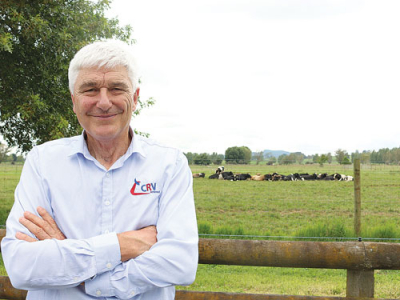 Phil Beatson, CRV Ambreed.
New Zealand's 4.8 million milking cows excrete 1000 tonnes of nitrogen a day in their urine, and 200 tonnes of this end up in groundwater, says CRV Ambreed.
The company says it calculated the daily numbers using existing data related to milk urea concentration in daily bulk milk reports.
Farmers could be using the milk urea concentration (MU) value on their daily bulk milk reports to calculate the amount of nitrogen their herd is excreting in urine and take steps to address that, says Phil Beatson, the company’s head of R&D.
He says the 200t/day that ends up in ground water “is an issue we must address now”.
“Not all farms are the same in terms of milk urea, nitrogen excretion and leaching from their cows. Reducing milk urea, nitrogen excretion and leaching is achievable quickly.”
MU is an indicator of how much dietary nitrogen (consumed by the cow as plant protein) is not being used for production and is excreted. Nitrogen excreted in the urine is particularly important because the high concentration of nitrogen in urine coupled with the small area of the urine patch means the plants and soil cannot cope with the nitrogen, and across all NZ about 20% is leached into groundwater.
Research from overseas and in NZ shows a direct relationship between MU and grams urinary nitrogen excreted per day per cow, Beatson says. On average the relationship between MU and urinary nitrogen is about 7 grams urinary nitrogen per 1 unit of MU. The average MU in NZ is 30 units, so the average cow is excreting 7 x 30 which is 210 grams of urinary nitrogen a day. With 4.8 million cows in milk, nationally there is 1000 tonnes of nitrogen hitting the ground in urine every day, he says.
Beatson uses an example of a herd of 500 cows whose bulk milk MU on a day is 30 units, combined with the best estimate of the MU-UN relationship of 7 grams urinary nitrogen per unit of MU. On average, each cow is peeing out 7 x 30 = 210 grams urinary nitrogen and the herd is excreting 500 x 210 grams = 105,000 grams nitrogen in urine per day, a total of 105kg a day on that farm.
He says the effective way to deal with the nitrogen leaching issues is to reduce the amount of nitrogen hitting the ground, and that means changes in the way we breed and feed cows.
Beatson says the MU value in bulk milk reports holds the key to this. Although the MU and urinary nitrogen relationship differs slightly from cow to cow when individual cows are considered, when a herd is considered, the average MU of the group relates tightly to the MU-urinary nitrogen relationship of 7 grams urinary nitrogen per unit of MU.
This means that the bulk milk MU is a good predictor of urinary nitrogen on a per cow basis, and, when we multiply by number of cows, on a per herd basis, he says.
While the average NZ herd sits around the MU 30-unit mark, some herds have a much lower average MU and some have much higher average MU.
Dairy farmers are one step closer to breeding cow with lower methane emissions, offering an innovative way to reduce the nation's agricultural carbon footprint without compromising farm productivity.
CRV has produced the first homozygous polled bull to make New Zealand’s prestigious Ranking of Active Sires (RAS) list, demonstrating the strides the company is making in breeding top-quality polled bulls.
As Mycoplasma bovis (M. bovis) resurfaces in Canterbury, CRV is reassuring dairy farmers it has rigorous production processes and health testing programmes in place within its supply chain.
A Canterbury Hereford stud specialising in providing beef genetics for the dairy industry is claiming a major breakthrough in breeding for more environmentally friendly animals, with reduced urinary nitrogen emissions.
Some dairy farmers could be missing out on up to 160 kgMS of production because they are not herd testing.


DairyNZ deputy chair Cameron Henderson has been re-appointed unopposed for another term.
Farms across the upper North Island are trialling different pasture mixes as part of a research programme that aims to build greater resilience into farming systems.
Election years are always a concerning time for farmers, according to DairyNZ chair Tracy Brown.
The Ballance Farm Environment Awards are coming to the West Coast of the South Island.
Most dairy regions around the country have had a pretty good season so far says Tracy Brown.



OPINION: It seems Canterbury processor Synlait is still in the doldrums.
OPINION: Get offside with New Zealand First leader Winston Peters at your own peril.