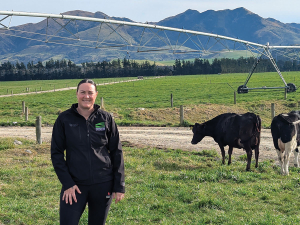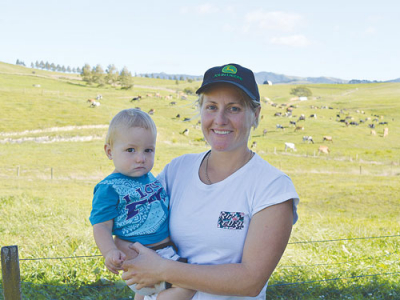
For the past few seasons, 13% of the herd have returned empty at the final herd pregnancy test. So the farmer, Sarah Wilson, planned to bring empty rates below 10%.
Visiting National Fieldays last year, Wilson, who milks 210 cows with her mother and stepfather, discovered BEC Feed Solutions’ Selisseo organic liquid selenium supplement.
BEC Feed Solutions country manager Trina Parker told Wilson about Selisseo, which she introduced to her cows in late June last year; this season empty rates dropped to 9.6%.
“That was a really good result for us,” Wilson told Dairy News.
“We had quite a wet spring and we were expecting an empty rate higher than before…. The only other thing we did differently was put heifers and second calvers on once-a-day over mating.
“But I attribute the drop in empty rates largely to Selisseo.”
The trace mineral in liquid form is given to cows with water at a rate of 0.25mls/cow/day.
The cost of Selisseo is about $21/cow/season; Wilson says the cost is covered “pretty easily” by the resulting reduction in the cows’ empty rates.
The trace element also helps keep somatic cell counts down, lifting milk quality and suppressing mastitis-related costs, Wilson says.
“Somatic cell count has never been an issue for us but using Selisseo has seen it go down further. It dropped 11% for the season…. At one point it was down 46% for the month in early calving.”
For Wilson, the only downside to using Selisseo is its pungent smell.
“It doesn’t upset the water or the animals but it has a distinctive smell….but not too much of a problem……like if my boss is feeding out I know, even while working in the cow pit, that he has given the cows Selisseo.”
The farm gets about 1500mm of rain every year; summers can get really hot. Adequate selenium levels in cows help reduce heat stress.
Cows are fed 1-2kg of PKE daily; production on the farm has topped 78,000kgMS -- about 380kg/cow.
Wilson’s husband Hayden works in forestry, and she gets to milk the cows. She has a son, Quinn, aged 18 months and finds being a farmer and mother a juggling act. Her mum looks after Quinn when she milk the cows.
Having happier, stress-free cows make the tasks easier, she says.