The week-long Gulfoods in Dubai had around 500 exhibitors representing 20,000 brands with tens of thousands of visitors each day.
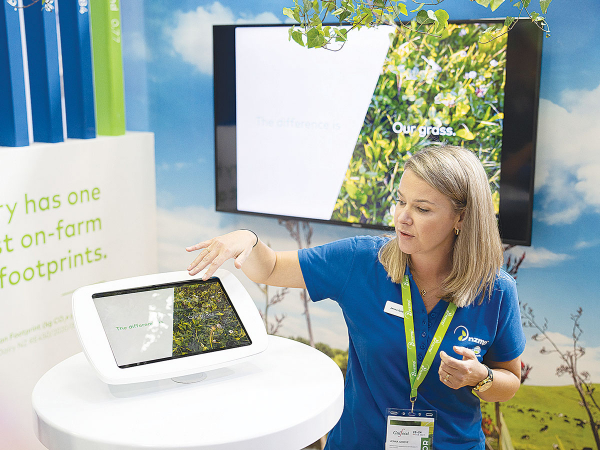
Fonterra sustainability solution team member, Jenna Grieve, says with that many people involved, it was important for the co-operative to stand out from the crowd.
"We certainly didn't leave anyone wondering why New Zealand dairy products are so great, clearly illustrating that our ingredients are both grass-fed and, of course, sustainably produced," says Grieve.
Sustainability was at the core of Fonterra's strategy and also what customers demanded from the co-op, so it was important to share that with the world, Grieve adds.
The co-op has two main focuses when talking to customers: Fonterra's low-carbon dairy advantage and New Zealand's grass-fed difference.
With the low-carbon dairy advantage, Fonterra illustrated how its products could help reduce the customer's own carbon footprint so they could secure future investment, while New Zealand's grass-fed difference was about consumer trends around wanting more natural food options.
Fonterra products on display at Gulfoods included its innovative NutriWhite milk powder, the potential of proteins in a range of applications - like spoonable and drinkable yoghurt and Anchor Food Professionals (AFP) products, like cream cheese and whipping cream.
AFP expert pastry chef, Ronny Keyrouz, was on hand to prepare delicacies using Fonterra products.
He used Anchor cream, cream cheese and butter sheets to prepare brownies, cheese cakes, cookies and pasta for visitors to tase.
For NZMP, the team focused on showing how they can creatively help customers fortify different products with extra protein.
Fonterra's global customers also heard about the many extra services Fonterra offers to make their life easier - like price risk management solutions and myNZMP for quick online ingredient sales.
Fonterra says Gulfoods is a place that's invaluable for gathering market insights on the latest trends.
The co-op's regional sales manager for Middle East and Africa (MEA), Adam Lyall, noticed that health and wellness and protein fortification continues to be top of mind for consumers.
"And our ingredients play right into that," says Lyall.
Fonterra representatives also spoke at the event.
Grieve and Mark Casey, Fonterra trade manager for Europe and MEA, took the stage to participate in discussions revolving around sustainability.
Grieve shared a presentation on how Fonterra is working to make the dairy industry less carbon intensive, and shared many of the game-changing methane innovations the co-op is testing.
Casey participated in a panel discussing the future of animal-based food.
Grieve says the co-op's presence at Gulfod takes many months of planning and preparation by the MEA team, as well as teams from across the business.