
PGG Wrightson Revenue Tops $1.1b as Profit Jumps 46%
After delivering a strong financial year, rural trader PGG Wrightson says the coming months will depend on customer confidence and weather.




 increase font size
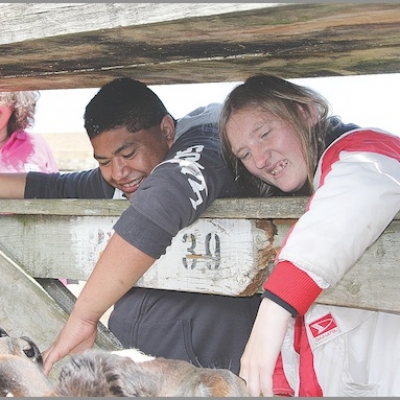 Matthew Mikaere and Stacey Cowdell check out some calves.
FARMERS HAVE this year donated 130,000 calves to be sold as fundraisers for people with intellectual disabilities.
IHC has run the Calf & Rural Scheme for 30 years raising $28 million over the years; PGG Wrightson is a major sponsor.
The first sale of the year was at the Paeroa saleyards on October 24.
Peter Moore, general manager of PGG Wrightson Livestock and Adele Blackwood, IHC national manager fundraising development, were on hand to see 118 calves sold.
Blackwood says the scheme was launched by the families and supporters of IHC.
“Norm Cashmore, Te Kuiti, and IHC Calf & Rural Scheme patron Sir Colin Meads developed it with other volunteers around the country. This was soon followed by the partnership with PGG Wrightson… attracting farmer support for IHC and people with intellectual disabilities.
“We are fortunate to have the loyal support of about 5000 farmers who each donate one or more weaned calf (a virtual calf or even a cull cow) to the scheme each year.
“We arrange transport to saleyards at one of the 19 IHC stock sales organised by PGG Wrightson.”
Helpers include farmers, canvassers, truckers and PGG Wrightson staff.
PGG Wrightson’s support includes promotion, farmer awareness, advertising of the sales, and the sales process, Blackwood says.
“IHC does a tremendous job for people with intellectual disabilities and our sponsorship of this scheme is a way to help those people, their families and the communities which donate the calves.
“The funds raised from the Paeroa sale, for example, come back to that community to enable services and support not funded by Government.”
Blackwood says the scheme generates about $1.5 million per year.
“This helps create a better life for people with intellectual disabilities through… advocacy, self-advocacy, one to one volunteer friendship and the free IHC library, the biggest of its kind in the southern hemisphere.”
After delivering a strong financial year, rural trader PGG Wrightson says the coming months will depend on customer confidence and weather.
Food rescue charity Meet the Need has released its 2025/26 Impact Report, revealing a record year of growth alongside a stark warning: demand for food support across New Zealand is rising faster than supply can keep up.
Strong competition and tightening supply have seen wool reach its highest prices paid at auction since 2011.
A firm belief in the agricultural sector has kept the PGG Wrightson business going for 175 years, says chief executive Stephen Guerin.
Strong farmgate milk price is helping boost investment on farms, says PGG Wrightson chief executive Stephen Guerin.



LIC shareholders have elected a new North Island representative to the co-operative's Board, along with five representatives to its Shareholder Reference Group (SRG), following the company's Annual Meeting held in Invercargill.
Farmers across parts of Southland and South Otago are continuing to deal with difficult conditions after a prolonged run of wet weather, with pressure building around feed supply, stock management, pasture damage, farm infrastructure and everyday workloads.
Federated Farmers says it welcomes Labour's commitment to reviewing the Sharemilking Agreements Act, calling on other major parties to do the same.
For Canterbury dairy farmers Sian Meijer and Rick Wobben, wearable technology has become one of their most valuable on-farm tools - helping manage 1850 cows across an expansive, high-performing dairy operation while improving efficiency, mating outcomes and day-to-day decision making.
Fonterra has unveiled its annual results for the 2026 financial year, posting $27 billion in revenue and close to $20 billion returned to New Zealand farmer owners and unit holders.
The first major update to the Dairy Cattle Code of Welfare in more than a decade has been released, marking what DairyNZ describes as an important step in ensuring animal welfare standards continue to evolve alongside scientific evidence and on-farm realities.
OPINION: It seems Canterbury processor Synlait is still in the doldrums.
OPINION: Get offside with New Zealand First leader Winston Peters at your own peril.




