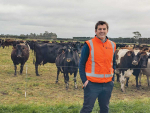
New Dairy Holdings CEO Backs Self-Contained Model
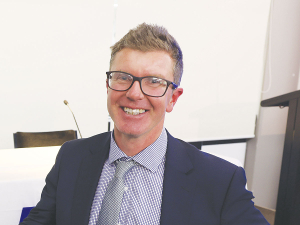
Running a tight and self-contained ship is the key to the success of the country's largest dairy farmer, says Blair Robinson, the new man at the helm of Dairy Holdings.




 increase font size
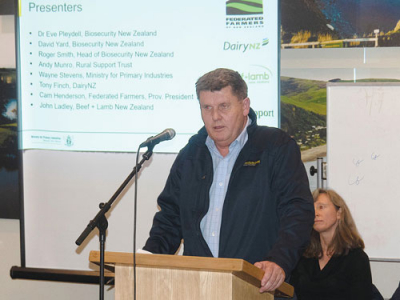 Roger Smith.
The Mycoplasma bovis outbreak is heading for its first real crunch point in a couple of weeks with the start of the next round of bulk milk tests.
According to the head of Biosecurity New Zealand, Roger Smith, the results obtained from the bulk milk tests will be a telling moment in knowing the spread and nature of the disease.
Smith last week met with the chief executives of DairyNZ and Beef + LambNZ and other industry reps to discuss how the eradication is tracking; so far there are no surprises with just three more herds confirmed as infected.
As of last week 59 farms are confirmed as having M. bovis and 37 more are ‘active’ (having more tests).
Smith is not surprised that more herds are confirmed as infected because they were seen as likely to be. But it’s the results of bulk milk tests that will give a much more accurate onfarm picture.
“We would know the results the day after the first test, but it is comprehensive testing so there are six rounds. The final results will be out in November but we will have the North Island results in early-mid October and the South Island results after that.
“The results will give us a good view of whether things have panned out the way we expected with just a few farms infected. But if we get a lot more infected farms or farms where we cannot trace back where the disease came from, that would raise questions for us.”
Smith says a ‘drop-dead’ point would be the sudden discovery of strains of M. bovis different from those so far found.
Everything is being examined and the team will set up ‘technical triggers’, essentially asking if the strategy of eradicating M. bovis is still feasible and acceptable to industry.
These things need to be done with the backing of industry, Smith says.
“The position has always been that this is being done for the industry and in the end if eradication is not the right thing for the industry then a decision would need to be made and that would be a decision of the Government,” he says.
No more apathy
Meanwhile a change of heart is seen about M. bovis among North Island farmers.
DairyNZ’s Andrew Reid says at one stage many North Island dairy farmers regarded the disease as a South Island problem, but he says this is no longer the case.
“The sense of apathy we might have found across the North Island this time last year towards M. bovis has disappeared. We are seeing a lot more interest in onfarm biosecurity across the country.
“Questions are being asked about the use of service bulls, about mating policies and trading stock, and a lot more due diligence is being done on farms to make sure stock being brought onto farms are free of M. bovis or whether they may have been exposed to the disease,” he says.
Reid says farmers are now more perceptive and aware of their responsibilities to look after their farms and themselves.
Running a tight and self-contained ship is the key to the success of the country's largest dairy farmer, says Blair Robinson, the new man at the helm of Dairy Holdings.
OPINION: It's no surprise that "world-class biosecurity" continues to dominate as the top priority for agribusiness leaders, holding the number one spot for the 16th consecutive year in KPMG's latest agribusiness report.
Compensation assistance for farmers impacted by Mycoplama bovis is being wound up.
New Zealand's world-first Mycoplasma bovis eradication programme is making great strides but this isn't the time for complacency, says Ospri.
A national pest management plan to eradicate Mycoplasma bovis (M. bovis) will come into effect by the end of this year.


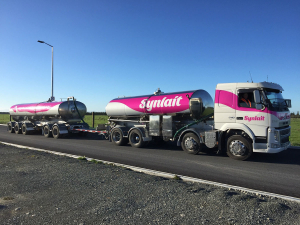
Synlait has swung to second-half profit as operations stabilise, but the dairy processor still posted a $75.4m annual loss.
LIC shareholders have elected a new North Island representative to the co-operative's Board, along with five representatives to its Shareholder Reference Group (SRG), following the company's Annual Meeting held in Invercargill.
Farmers across parts of Southland and South Otago are continuing to deal with difficult conditions after a prolonged run of wet weather, with pressure building around feed supply, stock management, pasture damage, farm infrastructure and everyday workloads.
Federated Farmers says it welcomes Labour's commitment to reviewing the Sharemilking Agreements Act, calling on other major parties to do the same.
For Canterbury dairy farmers Sian Meijer and Rick Wobben, wearable technology has become one of their most valuable on-farm tools - helping manage 1850 cows across an expansive, high-performing dairy operation while improving efficiency, mating outcomes and day-to-day decision making.
Fonterra has unveiled its annual results for the 2026 financial year, posting $27 billion in revenue and close to $20 billion returned to New Zealand farmer owners and unit holders.
OPINION: It seems Canterbury processor Synlait is still in the doldrums.
OPINION: Get offside with New Zealand First leader Winston Peters at your own peril.




