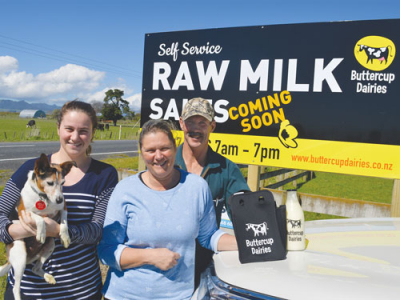
Milking 520 cows, they prioritise their environment, sustainability and animal welfare.
But the negative public perception of farming got them thinking. “We have a great product so we thought we’d allow the public to buy our milk at an affordable price,” says Glenda.
Last December they started research into selling raw milk sales at the farm gate; Buttercup Dairies was set up and raw milk will be sold from the farm this week. Village Milk, of Takaka, has helped the Grays set up the business.
An old cow shed has been renovated and 20 ‘shop cows’ have been selected to produce A2 milk for sale. Each cow will produce 20L of milk daily; Buttercup Dairies hopes to sell 300L of raw milk every day.
An Italian milk dispenser has been installed, and buyers can buy $4 glass bottles to collect milk from the dispenser. “Glass is best as this can be easily cleaned,” Glenda says.
She says the shop cows have been specifically selected to produce A2 milk. “We have done this by DNA testing all our cows.”
All cows produce either A1 or A2 milk; milk protein is made up of 80% casein proteins and 20% whey proteins. There are four different kinds of caseins, one of which is b-casein (beta casein).
Beta casein comes in two different structure types -- A1 and A2. The difference between A1 beta casein and A2 beta casein is the amino acid at position 67 of the beta casein molecule. The difference in structure between the beta casein variants can lead to a difference in their breakdown during digestion. Many people say they are better able to tolerate A2 milk.
Buttercup Dairies will run a separate herd on a separate part of the commercial farm.
“The cows have been specifically selected not only for their A2 properties but are also young healthy cows. The Buttercup Dairies cows are pasture fed; no supplements of meal or palm kernel are fed and no antibiotics are used in this herd.”
Sellers of raw milk must be registered with the Ministry of Primary Industries and follow strict guidelines.
The old cowshed has been renovated to meet the latest MPI food safety standards.
Like other registered raw milk sellers, Buttercup Dairies does rigorous testing to ensure high milk quality.
“We send samples of milk away weekly to two separate testing facilities, aiming to keep harmful bacteria to a minimum while keeping the good bacteria and enzymes.
“MPI requires us to tell consumers of the risks in drinking raw milk if they have a compromised immune system.”
Natural from grass to glass
Raw milk goes direct from the source to the consumer, says Glenda Gray.
It is natural ‘from grass to glass’, and comes with naturally occurring bacteria, enzymes and proteins. Raw milk is presented in its original state – not pasteurised or homogenised.
Pasteurisation occurs when milk is heated to a minimum of 72oC for at least 15 seconds, then is rapidly cooled to 4oC.
Homogenisation mixes the cream evenly throughout the milk so a layer of cream doesn’t form at the top of the bottle.
Buttercup Dairies raw milk is fresh daily and has a recommended shelf life of four days.