Czarnikow Launches Digital Milk Pricing Tool in NZ
New Zealand dairy farmers are set to be the first in the world to receive access to a new digital physical milk pricing tool that enables them to fix the price for their physical milk.




 increase font size
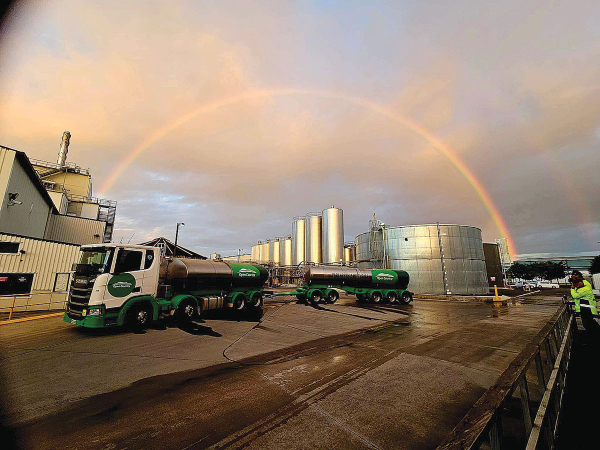 Open Country Dairy is telling its farmer suppliers that prices should increase further in the coming months. Photo credit: Open Country Dairy Facebook page. Callum Leslie.
Following two consecutive Global Dairy Trade (GDT) price rises this year, overall prices now sit at their highest since June 2023.
Prices have lifted by around 25% since last year’s low in August. Overall prices are now up 3% on a year ago, 4% below their 5-year average levels and 5% above the 10-year average.
Westpac chief economist Kelly Eckhold believes that expectations of reduced production data in New Zealand and offshore may still be supporting prices.
Last week’s GDT auction saw the price index rise 2.3%, while key whole milk powder (WMP) prices lifted 1.7%.
Eckhold notes that the result was again broad based and followed on from a similarly strong initial auction for 2024 in the first week of January. All products posted price rises.
Butter and anhydrous milk fat prices led the way, surging 5.8% and 4.3% respectively.
“We didn’t have a formal forecast for the WMP price result this time but the general trend in dairy prices is in line with the upward adjustment we made to the season milk price just ahead of Christmas,” he says.
“The futures market had pointed to a small WMP price rise at this auction, and so this auction modestly surpassed those expectations.”
On the demand side, last week’s auction saw demand from China, Middle Eastern and Southeast Asian buyers. But Eckhold remains remain cautious on prospects for the Chinese economy and associated Chinese dairy demand.
He noted that deflation in consumer and producer prices continued in China according to data from late 2023.
“We are retaining our milk price forecast for this season at $7.50/kg, in line with the mid-point of Fonterra’s guidance,” he says.
New Zealand dairy farmers are set to be the first in the world to receive access to a new digital physical milk pricing tool that enables them to fix the price for their physical milk.

RaboResearch senior analyst Emma Higgins expects the 2026/27 dairy season to be another profitable one.
A new Westpac NZ community banking van begins making visits around Northland this week.
OPINION: The good news keeps getting better for NZ dairy farmers.
Buyers trying to secure supply are keeping dairy prices at elevated levels.
New Zealand dairy farmers are set to be the first in the world to receive access to a new digital physical milk pricing tool that enables them to fix the price for their physical milk.
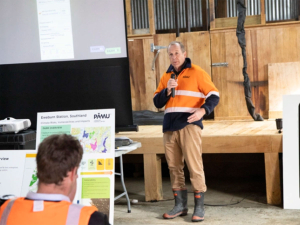
State farmer Pāmu is opening its farm gates this summer in an effort to give the rural sector the opportunity to see how large-scale, multi-system farming is delivering productivity and profitability across New Zealand.
A five-year study has found that the cost of reducing emissions without technology may be significant and unsustainable for Northland dairy farmers.
DairyNZ says Waikato farmers need certainty on Plan Change 1, but they say that certainty must be matched with practical, workable rules and a clear transition that doesn't get ahead of the new resource management system currently under review.
While the Government has moved quickly to make commercial hauliers' lot easier during the current fuel crisis, they appear to be stuck in the creep box when it comes to the agricultural industry.
Waikato farmers have been told that the Government’s new planning system legislation and the region’s Plan Change 1 (PC1) “won’t mesh together very well”.


OPINION: No one messes around with Winston Peters, more so in a general election year.
OPINION: Staying on Federated Farmers, this week's annual general meeting in Auckland is shaping up to be an interesting one.