
Fonterra CFO Andrew Murray Resigns
Fonterra Co-operative Group chief financial officer Andrew Murray has resigned to take up a role outside the dairy giant.




 increase font size
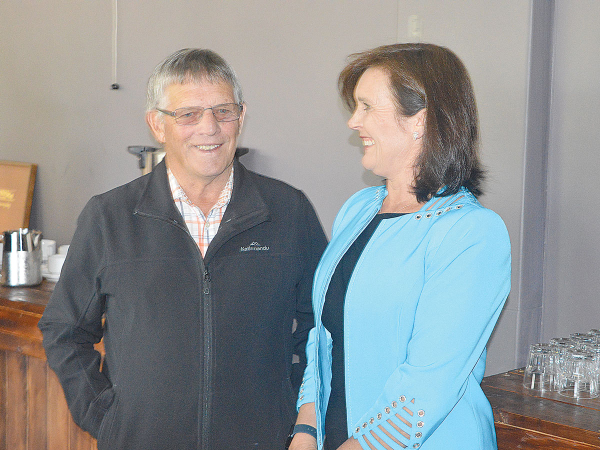 Fonterra director Leonie Guiney chats with Fonterra shareholder Murray Marshall at the AGM last week in Methven.
The change in government following last month's general elections doesn't change the need for an on-farm emissions target, says Fonterra chair Peter McBride.
He told the co-operative's annual general meeting in Methven last week that the strongest motivating forces are offshore.
Farmers, who have faced an avalanche of regulations under the previous Labour Government, are expecting a more sympathetic hearing from the incoming government, likely made up of National, ACT and NZ First. Both National and ACT favour delaying the agriculture sector's entry to any emissions trading scheme.
But McBride hinted that farmers shouldn't expect a change in Fonterra's sustainability drive because of changes at the Beehive.
"I do want to be very clear with you that, respectfully, the need for an on-farm target does not change because of the general election," he says.
"The strongest motivating forces are offshore and, from my perspective, are both geopolitical and commercial in nature."
McBride says being a leader in sustainability is a fundamental part of the co-op's strategy.
He cautioned that sustainability and emissions are also the new trade barriers.
"We could essentially be locked out of some of our most valuable markets if we cannot demonstrate emissions reductions."
He noted that the EU is introducing a Carbon Border Adjustment Mechanism that applies carbon tax to certain products imported into the EU. The EU is also looking to impose carbon charges on transport of goods to market, levied on all large ship entering their ports.
The other main commercial driver is access to funding and capital - for both the co-op and individual farming businesses.
McBride says the main banks and financial institutions have set emissions reduction targets.
"Our on-farm emissions and the co-op's operating emissions are a large part of their Scope 3 emissions, which they are seeking to reduce."
Some Fonterra farmers could switch their supply to other processors if Scope 3 target becomes financially difficult to achieve.
McBride acknowledged that some Fonterra competitors may use this as a procurement tool in the short term.
"But the commercial reality of doing business at scale internationally will capture all of us in time. They will be late to the table, and presented with an even bigger elephant to eat."
Fonterra Co-operative Group chief financial officer Andrew Murray has resigned to take up a role outside the dairy giant.

Four candidates have been confirmed for two director positions on Fonterra’s board.
A record farmgate milk price and strong global demand is laying the foundation for continued growth of organic dairy farming in New Zealand.
Waikato milk processor Tatua has again declared a record milk payout to farmer shareholders, leaving other processors in the dust.
Fonterra has unveiled its annual results for the 2026 financial year, posting $27 billion in revenue and close to $20 billion returned to New Zealand farmer owners and unit holders.


National’s pledge to introduce 19 new national standards shows the party is serious about getting Wellington out of farming, Federated Farmers says.
The National Party’s policies to make it easier to grow fresh vegetables, secure reliable water and energy and simplify farm planning are practical changes that will give growers the confidence to invest, according to Horticulture New Zealand (HortNZ).
Fonterra Co-operative Group chief financial officer Andrew Murray has resigned to take up a role outside the dairy giant.
A major move is about to get underway to improve the quality and viability of dairy beef and cattle in NZ.
Veterinarians say changes to the code of welfare for dairy cattle provides a positive foundation for improved cattle welfare across the country.
Today, 15 October, is the International Day of Rural Women, which recognises rural women’s contribution to farming, communities and the environment.


OPINION: It seems Canterbury processor Synlait is still in the doldrums.
OPINION: Get offside with New Zealand First leader Winston Peters at your own peril.




