What Would Synlait Be Worth to Fonterra or a2 Milk?
Speculation of a possible joint move by Fonterra and a2 Milk to buy Synlait raises a much bigger strategic question, says agribusiness expert Dr Nic Lees.




 increase font size
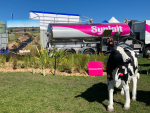
 Owl Farm manager Tom Buckley and demonstration manager Louise Cook.
Owl Farm at St Peter’s School, Cambridge is a venture by Lincoln University and seven commercial partners to demonstrate good practice on a working farm, while encouraging farmers and young people to succeed in the dairy industry.
A recent open day, hosted by the farm’s new demonstration manager Louise Cook, showed a report card that summed up the Waikato winter as wet, wet, wet.
Located on the banks of the Waikato River, the 148ha farm had 1436mm rain over the 2016-17 season compared to 953mm in the previous year. Rainfall in July and particularly August also showed a marked increase over last year.
Farm manager Tom Buckley gave the visitors an overview of the stocking regime: 421 milking cows versus last year’s 430 because of a decision to drop maize silage from the mix after paddock feeding resulted in poor utilisation.
Lameness persisted, though infections appeared less severe than in previous years, and mastitis followed a similar path despite a robust dry-cow and teat-seal policy at drying-off.
Calving was a little behind this season, compared to 2015-16 season; production was well above expectations, the herd producing at least 2kgMS/day on a grass-based diet supplemented by PKE until August 20.
Grass cover measured in early June was below the target of 2500kgDM/ha, but by the end of the month it had caught up and went on to exceed that target during July and August.
Wet weather as far back as April delayed the autumn application of nitrogen, which in turn postponed the first spring application to early July when 80kg/ha was applied; this will continue at 25kg/ha N as the grazing rounds progress.
Looking at all-important numbers from the previous season, stocking rate was 2.9 cows/ha, milk solids per cow was 421kg, and per ha 1221kg. At a $6.15 payout, the total production of 174,829kgMS yielded $1,127,891 from milk sales.
Operating expenses were $4.75/kgMS, leaving an operating profit of $1.63 and an operating margin of 25.6%. The financial position will allow the business to reduce debt; it plans to pay $150,000 of principal in six equal payments starting in December.
The farm also plans to improve milk cooling, always a problem there, with water arriving at the primary cooler at 17 - 19 degrees C, and tending to rise to 23 degrees C during high summer.
This can result in milking exiting the primary cooler at 18 degrees C at the start of milking, and up to 21 degrees C at the finish.
The farm water supply takes a convoluted route from the bore to the nearby Velodrome and on to St Peter’s School before it arrives at the farm; it can typically gain 7 degrees C on its journey. The need to improve the situation was clear, especially because the primary cooling circuit’s need to work overtime made energy consumption a key consideration.
After studying many available cooling systems the farm chose a variable-rate glycol based system that avoided an upgrade of the farm’s electrical transformer. The unit cost more than some but is calculated to roughly halve running costs and could save $4000 annually.
Speculation of a possible joint move by Fonterra and a2 Milk to buy Synlait raises a much bigger strategic question, says agribusiness expert Dr Nic Lees.

Lynnette Hudson's 30-year obsession with Pinot Noir was sparked working vintage in Burgundy, seeing how subtle changes in terroir were expressed in the glass. It was, she says, "an elightening moment in every way".
A four year trial has reaffirmed that mixing plantain into dairy pastures can help reduce nitrogen losses to freshwater while maintaining milk production and profitability, say researchers.
Twenty five secondary school students from around New Zealand recently completed a three day residential programme designed to explore career opportunities across the food and fibre production supply chain.
A Lincoln University student is set to become the first person to contest both the Young Viticulturist and the Young Winemaker national titles in one year.


Now in its fourth year, the 2026 Fencing Industry Awards, formed part of the proceedings of the FCANZ Conference, held in Nelson during August.
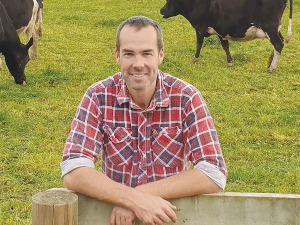
DairyNZ deputy chair Cameron Henderson has been re-appointed unopposed for another term.
OPINION: The stats speak for themselves.
Farms across the upper North Island are trialling different pasture mixes as part of a research programme that aims to build greater resilience into farming systems.
Election years are always a concerning time for farmers, according to DairyNZ chair Tracy Brown.
The Ballance Farm Environment Awards are coming to the West Coast of the South Island.




OPINION: It seems Canterbury processor Synlait is still in the doldrums.
OPINION: Get offside with New Zealand First leader Winston Peters at your own peril.