Cashing in on goat fibre
Last month's inaugural New Zealand Cashmere Conference saw the opening of a new fibre processing facility.




 increase font size
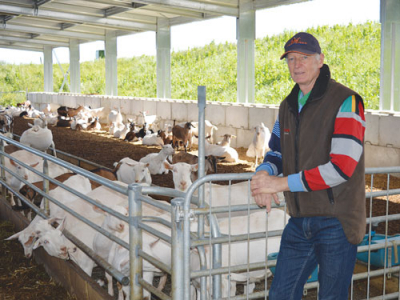 Peter Clarkin on his farm near Hamilton.
After rearing calves for 25 years Peter Clarkin was looking for a new challenge.
So two years ago he started researching goats, viable for his 55ha property at Temple View, outside Hamilton.
“I didn’t know much about rearing goats then,” Clarkin told Dairy News.
For the next two years Clarkin reared goats, mostly Saanen and Nubian breeds. Two months ago he started milking 1,000 goats on the farm with a new 72-bail internal rotary from GEA New Zealand.
The goats are housed 24/7 and fed freshly cut grass and silage. Dried distillers grain (DDG) pellets are fed during milking.
“Goats love the DDG pellets; they get 900 grams daily – 450g each milking.”
As Clarkin is milking first kidders on a new farm conversion, milk production is low, but, he expects production to reach on average up to 6L/day, as the goats mature.
Clarkin, a regular visitor to the US, visited housing barns for cattle. The shelter on his farm at Temple View has a high roof, designed for high airflow in summer.
Clarkin first saw the GEA NZ rotary at the Fieldays. Grant Coburn, GEA’s area manager, took Clarkin
to other farms with his firm’s rotaries.
He opted for a rotary with headlocks and no traditional bails; the advantage of this system is the goat is held in place feeding, making the animal a lot calmer during the entire milking process.
It’s running smoothly now, milking’s short and efficient, in the beginning however this was a challenge. Clarkin recalls the first milking started at 6pm and it took four hours to milk his goats. This has now reduced considerably to two hours even milking 1,000 goats.
“Staff are fully trained and settling into the new parlour,” he says.
Clarkin supplies milk to NZ Nutrition Milk Company, opting for this independent supplier over the Dairy Goat Co-op.
While milk payout is below the $18/kgMS paid by DGC, Clarkin says he didn’t have to buy shares to supply NZ Nutrition.
Last month's inaugural New Zealand Cashmere Conference saw the opening of a new fibre processing facility.
Former All Black Kevin Schuler says diversifying the family farm with his brother Paul into three milking systems – cows, goats and sheep – is all about creating a better and stable business.
Garrick Batten on why there should be more farmed goats.
Goats can add simple and low-cost production benefits to bottom-line profitability for sheep and beef operations, explains Garrick Batten.
Garrick Batten on why there aren't more goats on pastoral farms.


A Palmerston North shearer has been sentenced to six months' community detention and 12 months' supervision after being found to have physically abused three lambs while shearing them.
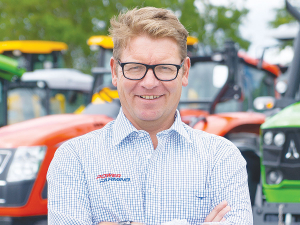
Power Farming has launched a joint venture in Southland.
Food rescue charity Meet the Need has released its 2025/26 Impact Report, revealing a record year of growth alongside a stark warning: demand for food support across New Zealand is rising faster than supply can keep up.
As we move into the second half of 2026, the Tractor and Machinery Association (TAMA) reports that Year-to-Date figures ending June 30 saw new tractor deliveries hitting 1,386 units or 10.7% ahead of the same period in 2025.
The avocado sector is entering the new season with a larger crop and positive market opportunities.
New Zealand growers have always adapted to changing conditions, but one challenge is steadily gaining ground across the horticulture sector: resistance.

OPINION: The Irish dairy sector is facing a new dilemma - maintaining year-round fresh milk supplies.
OPINION: Could beef cows play an increasingly important role in improving profitability and resilience on hill country farms?