New export records for Aussie goatmeat
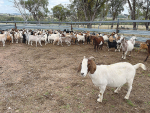
The Australian goatmeat industry set a new record for production and exports last year.




 increase font size
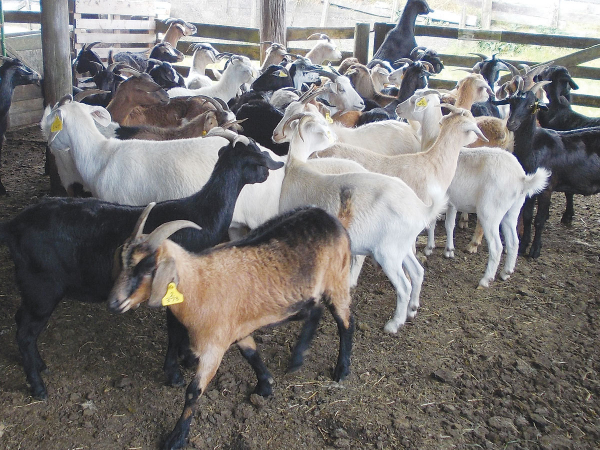 Goat meat has no age, sex or carcase finish specifications and consistently stable schedule value between 8 and 18 kg.
Goats can add simple and low-cost production benefits to bottom-line profitability for sheep and beef operations, explains Garrick Batten.
Our feral goats are low-cost breeding stock with a widespread genetic base to work with.
Mated to appropriate bucks, they are just as suitable as other breeds. Controlled by relatively cheap effective electric fencing when trained, they can be handled on the few needed occasions in existing facilities with only minor modifications.
Sheep farmers most enjoy working with animals and producing healthy stock. They least enjoy animal health problems, dagging, docking, dipping and repeat manual work.
Appropriate goat grazing management significantly reduces or eliminates sheep drenching at $2.20 per SU, no wool shearing, tailing, dagging at $3 per SU, disease or pregnancy testing or even vaccinations in the yards. No viral pneumonia, flystrike, bearings, cast ewes, reproductive difficulties, facial eczema to monitor and cure. Easier and quicker mustering and yard work with intelligent, easily trained goats.
Feed cost is directly related to goat stocking rate per ha. Free-ranging low numbers have minimal additional feed cost. Adding 10% of goat LW to existing farm stock LW, will mainly eat unused and currently wasted feed on hill country. Clover percentage in mixed pasture will improve over time at no cost and can be increased by 25%-plus with more concentrated goat rotational grazing. Measuring that benefit from improved feed quality in other stock is difficult, but increased store lamb weight from 23-29kg on clover enhanced pastures could add $25 per head and earlier disposal.
Goats have a key biological weed control of environmental benefits without chemical and diesel use. There’s also no work safety and application timing considerations costs, but income from four-legged control. Even one thistle per 10m² reduces pasture by 8%. Goats also control scrub weeds as well.
Farmers compare meat prices based on their experienced knowledge of animals, products and markets. Goat meat has no age, sex or carcase finish specifications and consistently stable schedule value between 8 and 18 kg. Being able to use goats as a flying herd to reduce farm stock levels for any climatic reason – without price penalty – can be a significant management advantage.
Goats can have other advantages over cattle to groom longer pasture. As they do not like water, even the $5 per metre, two-wire cattle fence and alternative water sources are not required for waterway exclusion.
There is also no NAIT, TB or pregnancy testing expensive handling equipment. No pasture treading damage in winter with lower hoof pressure. Urine patches are spread more, less intense, with reduced N loss and contamination.
All animals die and have health problems by the head, so such events are significantly more important with cattle. Cattle reproductive rate, and capital and husbandry costs comparisons are magnified by the goat alternative.
• Garrick Batten is a lifetime commercial goat industry expert and published author. More information: www.caprinexnz.com
The Australian goatmeat industry set a new record for production and exports last year.

Last month's inaugural New Zealand Cashmere Conference saw the opening of a new fibre processing facility.
Hill country farmers cannot ignore the goat meat market opportunities such as in North America, according to goat farming expert Garrick Batten. He outlines why in the third of his three part series on the topic.
The US goat meat market provides profitable potential for NZ hill country farmers, in Garrick Batten's opinion. From his extensive industry background, he discusses this potential in the second of three articles.
Former All Black Kevin Schuler says diversifying the family farm with his brother Paul into three milking systems – cows, goats and sheep – is all about creating a better and stable business.


New Zealand's citrus growers were challenged to build their future on the value embedded in their fruit rather than the volume they produce, at Citrus New Zealand's annual gathering in Gisborne on 17 September.

Leading John Deere technicians and apprentices from New Zealand and Australians were recognised at the recent sixth annual JD Technician of the Year Awards, held in Brisbane.
In Dacre, near Invercargill in New Zealand’s South Island, Bruce Dinnington is running a dairy operation unlike any other.
A free online platform aggregating governance vacancies across rural and regional New Zealand has been launched.
Environment Minister Nicola Grigg has announced details of a new rural plastics recycling scheme.
Agricultural drone operators say that a government decision to allow lower-risk drone work without certification won’t lower standards but drive innovation and efficiency.





OPINION: The same mainstream media muppets that brought you Jacindamania in 2017 have been flat out pimping for the Opportunities…
OPINION: Your old mate reckons the atrocious way farmers in the UK are treated by their lords and masters in…




