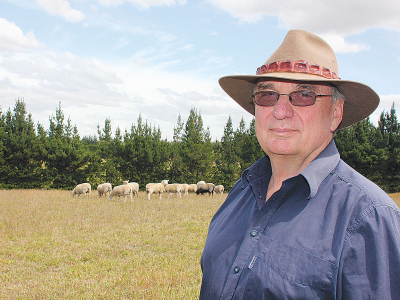

Moffett has launched a political party to help New Zealand farmers struggling with climate taxes.
He says NZ’s heavy reliance on International Emissions Trading Scheme (ETS) credits dangerously exposes the country to one of the world’s most volatile markets.
Moffett says he has researched the Paris Agreement and concluded it will be costly for NZ.
Today, the former New Zealand Rugby Union boss has 10ha across properties at Ashley and Broomfield, North Canterbury, where he runs small numbers of sheep and horses.
As founder of the New NZ Party, Moffett wants NZ to withdraw from the Paris Agreement, which binds the country to a range of targets for reducing greenhouse gas emissions.
“Paris makes it compulsory for us to contribute tax payments to other economies,” he claims.
“Many of them are of dubious honesty and accountability and are rife with corruption.”
Moffett believes the cost to Kiwis of the ETS and the Paris agreement are considerable.
The Government’s own estimates put the cost at $14 billion to $36b from 2021 to 2030 and that is likely to be the tip of the iceberg depending on supply and demand for carbon credits.
He says to put that into context, ACC raised $5.9b in 2018-19 with operating costs of $726 million.
“With over 2000 employees ACC at least contributes to the NZ economy.”
The agricultural sector long favoured managing its own emissions scheme but had succumbed to Government pressure, Moffett claims.
The Government recently announced that the agriculture sector would only be hit with 5% of their actual obligations under the NZ ETS.
Moffett says the New NZ Party doesn’t have an issue with the ag sector or other sectors paying this low rate, but believes business is being lulled into a false sense of security.
“Unfortunately, everyone in every sector will still pay for the full cost of the Paris Agreement. This is likely to exceed $4b per annum over 10 years, and that’s just for starters.”
He adds that the only way to pay for this would be through new taxes or a reduction in services.
“As an example, we pay 6.2c/L of petrol and 7.2c/L of diesel as an ETS levy,” Moffett explains.
“Incredibly we also pay GST on the total fuel excise which means paying an 11c/L tax on taxes. Together that represents 17c/L and 18c/L of hidden taxes.”
Moffett says every farming family is saddled with that burden, which is often made worse because of reliance on fuel to not only run their agricultural enterprises but also to travel long distances to get kids to school, go shopping, make doctor visits and the like.
The New NZ Party believes that declaring a climate emergency based on our emissions is the height of irresponsibility.
Moffett says the CO2 anthropogenic emissions by NZ of 0.17 % of the total agricultural emissions (AE) were meagre by comparison with many of our ag sector competitors.
Expressed as a percentage of the total CO2 fraction, which included AE, the result is 0.00006%, Moffett says.