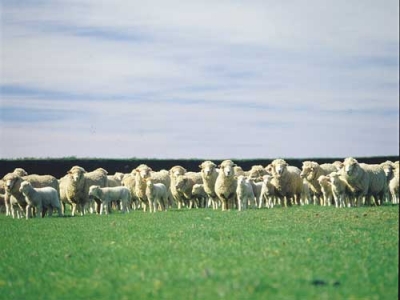
At Mangarata Farm in Wairarapa they are selecting for ewes that will ‘bounce back’ after lambing and conceive twins each year.
Mangarata Farm's ewe selection is an aspect of fine-tuning a breeding and finishing operation that could quickly bring gains from producing more quality finishing lambs.
The farm runs 4400 stock units on 476ha (eff) and is one of four commercial sheep and beef farms operated by the Taratahi Agricultural Training Centre.
The sheep breeding programme is based on high-performance composite and Romney genetics with an emphasis on per-head and per-hectare performance. They run two mobs – a maternal mob producing ewe replacements and a terminal mob producing fast-growing finishing lambs.
“We want to identify the type of top-performing animals that suit our management systems and fit into our commercial farming reality,” says Taratahi sheep and beef manager Paul Crick.
“We can’t necessarily finish all lambs at Mangarata because of our dry summers and topography. So the bottom line is we want all the ewes to have twins and wean their own bodyweight in lambs.”
To get an assessment of the ewes’ bounce-back ability from weaning, they’re using a combination of scanning and condition scoring, with all results recorded against each animal’s EID tag. The information is stored in an online database so it’s easy to sort through and analyse.
Crick says ewe body condition score is measured at weaning, pre-mating and scanning. They’re given every opportunity to perform.
“At weaning and pre-mating ewes are drafted according to condition score, and any ewe at less than BCS3.0 goes into a light mob that gets preferential treatment.”
After scanning, there is the moment of truth. The database will be used to create a draft list of inefficient ewes. These are ewes in the light mob that despite some special attention have still struggled to gain condition after weaning, and they are allocated to the terminal mob.
And with EID tags there is less need to get out the spray can or another colour of eartags, as a computer file of their numbers can be used to run the auto-drafter.
Crick says the combination of the selection policy and measurements through the year makes it clear which animals are best suited for Mangarata and that’s where the focus needs to be.
A quick calculation shows where the early monetary gain will be. If they can maintain the maternal mob’s lambing percentage at 160% (Mangarata’s 2014-15 result), they will get enough good quality replacements and be able to confidently run a higher proportion of ewes in the terminal mob, probably going from 35 to 50%.
With hybrid vigour, the greater number of terminal ewes will be producing lambs that grow quicker, are up to 2kg heavier at weaning and of a type more marketable as store lambs. That extra weight at weaning, at $2.50/kg liveweight, could be worth up $5 per lamb.
Crick says it’s a long-term strategy and the value equation is as much about the cost of not doing it. “If you do what you always did, you’ll get what you always got.”