I'm often asked what my next is going to be. My response is that people are probably bored with reading "obvious" stuff. Mind you, if farmers are questioned about these topics, it turns out that some don't always have a good understanding.
So, for those who might be unaware, I'm now going to discuss the intricacies of livestock breeding where certain aspects are described as "phenomena".
One that is commonly known about concerns hybrid vigour, which involves the "effect" of crossbreeding animals, resulting in offspring that outperform the parent breeds.
Another enigma concerns a sire's prepotency. Meaning his capacity to transmit superior genetic traits. This is a quick quick way of improving the entire flock or herd. But not all sires are prepotent, so it is necessary to progeny test the offspring from his first mating, to be sure they have inherited his good dominant points.
An alternate method of influencing breeding outcome involves “close” breeding (linebreeding), which can cause genetic characteristics to be firmly “fixed” (homogeny) and become ingrained.
The thing to understand is that linebreeding describes the process of breeding among animals that are related. Whereas “inbreeding” is a more extreme version – to the point of close relatives such as father to daughter or brother to sister. Nature will allow only so much of that before birth deformities, health problems and a reduction in fertility sets in.
Whilst linebreeding can produce remarkable results as far as inherited ancestral genetics go, you need to be aware that this applies to good and bad – so it’s important that standards are set.
Something else intriguing as regards farming cattle is “compensatory growth”. This is the ability to gain weight faster than usual in the spring, to make up for lack of weight gain over winter. Even to the extent of catching up with animals which were well fed all winter.
But that doesn’t mean you can get away with starving cattle. They always require an adequate maintenance diet. The thing is, if cattle are not unsettled by a feeding out routine, and not run in big mobs, they survive quite well by nibbling on short grass all day.
Anyway, we used to buy steers in the autumn, to winter before finishing in the spring. And to get them through, we had 15,000 bales of hay stored in barns – which meant spending all spring making hay, then all winter feeding it out. And on top of that, we’d grow crops of chowmollier. As well as having big stacks of silage.
But with all that work and expense, I soon twigged that it would make more sense to carry less over winter, with no supplementary feeding – and rely on compensatory growth in the spring.
And then money saved in expenses would go towards buying extra cattle in early spring. Cattle in hard condition off hill country. In other words, I’d let some other fool struggle through the winter with them.
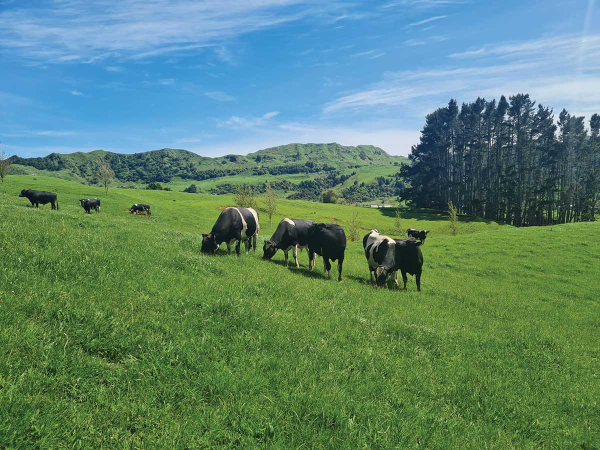
So those, along with the ones I’d carried through, would be lightly set-stocked among the ewes as soon as they’d dropped their lambs. Then after weaning, the cattle would have the good flat paddocks to themselves, in order for compensatory weight gain to do its thing.
Note: this will only work satisfactorily using quality bred cattle with potential to perform.
Kerry Butler farms in Waipawa, Central Hawke’s Bay